Showing posts with label BMW Reviews. Show all posts

Wednesday, May 15, 2013

BMW C600 Sport & C650 GT 2013 Review

A few days ago I left Malibu, California, bounding down the Pacific Coast Highway, the 10 and 405 freeways on my way home to Long Beach. When traffic allowed, speeds crept in excess of posted limits, and where traffic snarled to a crawl, lane splitting ensued. It’s a route I’ve traveled many times in the same fashion, only in this instance I wasn’t aboard a motorcycle. I was riding a scooter, for chrissake.
BMW’s C600 Sport, and its sibling C650 GT, however, aren’t normal scooters. These things are motorcycles masquerading as scooters by way of their step-through chassis and smaller wheels. When I think of a scooter, the ability of zipping around a tour bus in the HOV lane of SoCal freeway traffic doesn’t come to mind, but that’s exactly what I was doing on my ride home from the C600/C650 GT’s press launch.

The ability to aggressively navigate Southern California’s notorious 405 freeway on the cusp of rush hour should be testament enough of the confidence I have in C600’s performance beyond the typical scooter realm. But we also tested it along the winding, undulating hills behind Malibu and in the narrow streets of Venice Beach to sample how BMW’s new scooters handled these dissimilar environments.


The 647cc parallel-Twin powering both models produces enough power to accelerate either scooter well above any legal speed limit. Common among CVT transmissions, the C600/650 experiences a brief lag when launching from a stop, but by 4,200 rpm the centrifugal clutch is fully closed and you’re accelerating at max capacity. Around town, in the canyons or on the freeway the spritely nature of the engine is evident, and only the heft of the scooter holds it back from better performance.
With claimed wet weights of 549 lbs. and 575 lbs., for the Sport and GT, respectively, both C scooters aren’t lithe, but they are in the same realm as Suzuki’s Burgman (claimed 613 lbs wet) and Honda’s Silver Wing (claimed 551 lbs wet).
2013 BMW C600 Sport lean angleLook closely and you’ll see nearly limitless cornering clearance. We have yet to touch down a hard part. Notice also the attractive single-sided swingarm, a fixture on both models.
The weight’s carried low in the chassis, and combined with the 15-inch wheels, makes for a nimble scoot, even with their 62.6-inch wheelbase (4.2 inches more than BMW’s own R1200RT). The 26-pound heavier GT carries its extra weight high in the rear of the scooter, but this doesn’t cause any noticeable ill-handling effects.
Where you feel the weight of the Sport or GT is when the scooter gets a little off-center, which is easy to do considering their seat heights of 31.9 and 31.3 inches for the Sport and GT, respectively. The first stoplight we came to, in fact, caught me off guard when the reach to the ground was further than I was expecting.
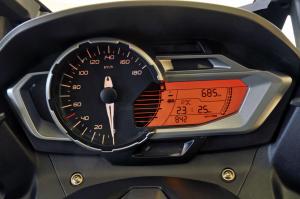
2013 BMW C650 GT instrument clusterInstrument clusters are slightly different from one another, but both supply the needed information in an easy-to-read format.
2013 BMW C600 Sport flexcaseWhen parked, the Sport can increase its storage capacity via the 'flexcase.' When not in use the flexcase easily collapses and secures to the bottom of the scooter.
As a six-footer with no seat height issues (especially when riding scooters) I couldn’t help but wonder what BMW engineers were thinking creating a scooter with easy-to-ride parameters for people with no or limited two-wheel exposure but with a seat height bothersome to someone of my stature and experience. I mean, 31.9 inches is taller than the seat height of most sportbikes!
Beneath those towering seat heights exists a 4.2-gallon fuel tank (enough go-juice for a 200+ mile range between fill-ups) and ample storage space. The GT boasts room enough for two full-face helmets at any time, while the Sport is outfitted with a “flexcase” that expands to fit two lids (or whatever) when the scooter is parked to allow for additional storage. Due to the close proximity of the rear wheel to the expanded case, the Sport will not start nor run until the flexcase is closed and secured. Both scooters feature an LED trunk light, a nicety you never knew you needed until experiencing it.
In addition to seat height and storage capacity, the GT differs from the Sport by way of better wind protection via its “Wind Guide Vanes,” an electric windscreen, more leg room between the seat and forward floorboards, a three-position adjustable rider backrest, and a slightly different instrument cluster. For all that, BMW asks only an additional $400 be paid: $9590 for the Sport and $9990 for the GT.
I certainly appreciated the GT’s extra legroom, and the small backrest kept me from slouching when my feet were positioned forward. During a long-haul trip (of which either scooter is fully capable) the comfort the backrest supplies will grow exponentially.
Because you never really know how you want a windscreen adjusted until after you’re in motion, the electrically adjustable windscreen of the GT is far more preferable than having to pull over and manually adjust the Sport’s windscreen.
2013 BMW C650 GT glove compartmentsBoth models offer dual, non-locking glove compartments. Our testers were equipped with heated seats and handgrips, a luxury of the Highline Package.
Both scooters are equipped with ABS brakes, and gripping handfuls of front and rear brake levers—with twin 270mm front and single rear disc brakes—commandingly hauls the hefty scoots to a standstill. Here again, less weight would only heighten braking performance, but at least BMW’s ABS system only adds an additional 1.5 pounds to the scooters’ weight issue.
Speaking of brakes, parking brakes automatically engage whenever the sidestand is extended, making sure your $10k scooter doesn’t inadvertently roll downhill.
2013 BMW C650 GT actionNearly 600 pounds rolling on 15-inch wheels, but you’d never know it by its handling mannerisms. The chassis of the GT and Sport allows a rider to attack the twisty bits with the kind of aggression usually reserved for sportbike pilots.
According to BMW, more GT models are scheduled for the U.S. than the Sports, while a large percentage of both models will come equipped with the Highline Package ($605), which includes heated seats and grips, a tire-pressure monitoring system and an anti-theft alarm.
While not as cold as other regions, California does experience winter, and riding the Sport to and fro at night with warmth emanating from the seat and grips is a worthwhile pleasure. Is the Highline Package worth the asking price? If you’re truly considering purchasing a $10k scooter, what’s another $600?
BMW’s research shows that the majority of purchasers will opt for the more expensive GT model with the additional priceload of the Highline Package. Having ridden both and experiencing no real downside to GT ownership, we agree that the extra amenities of the GT for just an extra $400 makes it the more rational choice.
2013 BMW C650 GT and C600 Sport
By the Numbers
 BMW C600 SportBMW C650 GT
MSRP$9,590$9,990
Engine Typeliquid-cooled in-line Twin four-stroke
Bore x Stroke79mm x 66mm
Displacement647cc
Horsepower60 bhp @ 7500 rpm
Torque49 ft-lb. @ 6000 rpm
Compression Ratio11.6:1
Valve GearDOHC, chain driven with bucket tappets
Valves2x31.5mm intake / 2x27.1mm exhaust
Engine Oil Capacity3.5 quarts
Engine ManagementBMS-E BMW Digital Engine Management
FuelPremium unleaded
Fuel Capacity4.2 US gallons
Charging System588 Watts @ 14 Volts
Battery12 Volts 12 Amps/hour maintenance-free AGM
Cooling SystemWater-cooling with oil heat exchanger
TransmissionCVT with centrifugal clutch
FrameTubular steel with die-cast aluminum sections
Front Suspension40mm upside-down fork with 4.5 inches travel
Rear SuspensionSingle-sided swingarm with 4.5 inches travel
Brake SystemBMW Motorrad ABS - Standard
Front BrakesDual discs, two-piston floating calipers
Front Rotor10.6 inch dual rotors
Rear Rotor10.6 inch single disc
Front Wheel3.50x15 cast aluminum
Rear Wheel4.50x15 cast aluminum
Front Tire120/70 x ZR 15
Rear Tire160/60 x ZR 15
Length84.8 inches87.3 inches
Width34.5 inches36.0 inches
Wheelbase62.6 inches
Seat Height31.9 inches31.3 inches
Steering Angle64.6 degrees
Front Wheel Trail3.6 inches
Dry Weight509 lbs. excluding options and accessories536 lbs. excluding options and accessories
Wet Weight549 lbs. excluding options and accessories575 lbs. excluding options and accessories
Maximum Load981 lbs. GVWR
Available ColorsTitan Silver Metallic
Sapphire Black Metallic
Cosmic Blue Metallic Matt
Sapphire Black Metallic
Vermilion Red Metallic
Platinum Bronze Metallic Matt
Available Equipment$605 Highline Package (heated seats, heated grips, TPM)
$395 Anti-Theft Alarm


BMW S1000RR HP4 2013 Review

If the Japanese and Italian sportbike manufacturers weren’t yet quaking in their boots by the fabulously engineered S1000RR, the HP4 will surely make them fret. The standard S1000RR topped our rankings in our recent European Literbike Shootout, and the HP4 significantly ups the ante of what’s possible with a street-going superbike.
Just five years ago, the idea of BMW building a supersport literbike that could manhandle the class’s established players would’ve been a fanciful one. But that’s exactly what happened. It took class honors in our 2010 Literbike Shootout, and several subtle revisions for 2012 added up to significant improvements when we tested it at its launch in Valencia last fall.
Less than one year later we’re back in Spain for the HP4’s launch, this time at the Circuito de Jerez, home of the Spanish Grand Prix. Never has a bike this fast been so easy to ride.


What’s In a Name?
The HP4 is the fourth model in the series of HP bikes kicked off in 2005 with the introduction of the HP2 Enduro, a high-end version of the R1200GS. The Boxer-powered HP2 line was later joined by the HP2 Megamoto, a supermotard version of the Enduro, and then came the roadracing-oriented HP2 Sport Pete rode in 2007. Consider the HP sub-series like BMW’s M automobile division.
To bring the S1000RR into HP territory, it’s fitted with a bevy of hardware and software upgrades. In the hardware section, aluminum wheels are now created by forging instead of casting, which results in lighter 7-spoke wheels. Together with a lighter sprocket carrier, the HP4 shaves a considerable 5.3 pounds of rotating mass. Also new are Brembo’s monobloc brake calipers replacing the RR’s two-piece binders.
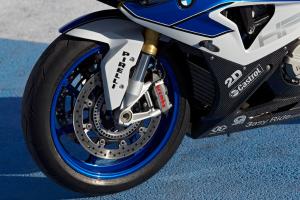
2013 BMW S1000RR HP4 Front WheelThe bike’s Race ABS and traction-control systems are newly optimized for racetrack use, and the ECU now has a launch-control function. The HP4’s rear tire is widened to the 200/55-17 size we first saw on Ducati’s incredible Panigale, and the RR’s optional GSA quickshifter is fitted as standard equipment.
The four-cylinder engine’s class-dominating peak power is unchanged, but a titanium Akropovic exhaust helps give it a welcome boost in midrange output and trims nearly 10 pounds of weight. The HP4 gets cosmetic enhancement with a racy blue-and-white paint scheme, a solo-seat configuration and a tinted windshield. A smaller and lighter 7-aH battery helps make the HP4 the lightest four-cylinder literbike, scaling in at 439 pounds with its fuel tank 90% full.
2013 BMW S1000RR HP4 Akrapovic ExhaustMmmm, Slovenian exhaust technology wrought from titanium… Note also the HP4’s various carbon fiber bits.

A World’s First – DDC
Headlining the upgrades to transform a RR into an HP4 is Dynamic Damping Control, a semi-active suspension system that automatically adjusts damping every 10 milliseconds based on how the bike is being ridden. The DDC’s control unit is mounted in the bike’s nose, and it’s fed data from wheel-speed sensors, throttle position, the shock’s travel position and the traction-control system, including its bank-angle data.
When set to one of the HP4’s street settings, Rain or Sport, DDC delivers a more compliant ride to absorb various road imperfections. Valving becomes tighter in the Race and Slick modes. Within each, the rebound and compression damping settings can be dialed up or down over 15 steps via the handlebar switchgear and updated instrumentation display. Spring preload adjustments require tools.
2013 BMW S1000RR HP4The HP4 features the world’s first semi-active suspension on a production sportbike. The system is fed a myriad of data from the bike’s electronics systems to automatically adjust suspension damping via electric signals.

Because the system is “dynamic,” the electrically actuated suspension valves (first seen on BMW’s 1997 7-Series car) actively change their damping rates based on data pouring into the ECU. So, for example, while the damping is restricted for best control during racetrack use, the computer’s bank-angle sensor can inform the DDC to dial back damping when cornering at a deep lean when forces going through the suspension are less direct.
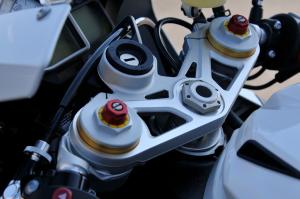
The right-side tube of the Sachs inverted fork carries the manually adjustable spring, while the left leg contains the damping circuits. Unlike the rear shock, the fork has no provisions for sending suspension-travel data. Optional from BMW is a fork travel sensor that hooks up to a provided input in the DDC computer. This allows for compression- and rebound-damping settings independent of each other.
The DDC performed flawlessly at Jerez, but it’s easy enough to get a good setup on a top-level sportbike for riding on a smooth GP track. DDC’s biggest benefit is likely to be felt on the street. To test the DDC in a street-ish environment, I noted the suspension behavior while riding Jerez’s bumpy pit lane. Then I shut off the ignition and observed harsher damping without the active damping in play.  
2013 BMW S1000RR ForkSpring and damping functions are separated in the HP4’s fork tubes.
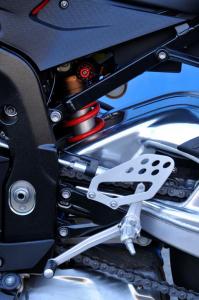
2013 BMW S1000RR HP4 Fork CutawayThe shock’s electrically controlled damping valve is seen above the spring in this cutaway shot.
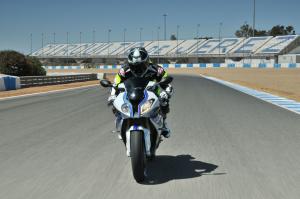
Although our testing of DDC was limited, it is surely a leap forward, and one that’s only going to get more impressive as it gets further developed. We will definitely be seeing DDC and systems like it on more production bikes in years to come, as the cost of the components likely aren’t very high. When I asked some BMW reps how much the system adds to the cost of the bike, and I threw out a 500 euro value, none of them balked at that price, so the additional hardware probably costs only a few hundred dollars. The system’s greatest cost is the considerable development time needed to finely tune it. 
BMW’s On Track
Two items to note: First, how privileged motojournalists are to be caning sportbikes no one else has yet seen in person around a superbly entertaining Grand Prix circuit. And, second, how a production streetbike can make a GP track seem so small!
As is well known by now, BMW’s four-cylinder engine is simply the class of the field, spitting out nearly 180 horses at its back wheel. BMW engineers say the HP4’s powerband has a punchier midrange in the 6000 to 9000-rpm zone, but its peak crank-rated power of 193 PS is unchanged despite the addition of the Ti Akropovic exhaust.
2013 BMW S1000RR HP4 FrontHowever, more power can be unleashed by replacing the mid-pipe and its catalytic converter, plus removing the muffler’s baffle – both of which disqualify the bike from legal road use. We’re told more than 205 at-the-wheel horses can be produced when fitted with the full exhaust treatment, a race ECU and race gas! (A journalist with deep racing connections told me BMW’s WSB engine is able to make as much as 240 hp for use at high-speed tracks like Monza.) Our test bikes were fitted with the standard Akro exhaust but had their baffles pulled. To my ears, it didn’t sound objectionably louder than S1000’s exhaust.
Honestly, more power was the last thing I was looking for while blasting around Jerez. And despite riding on a GP circuit, I never got out of fourth gear! There is so much power on tap that wheelies are a regular concern on the HP4. Wheelies are attenuated in the first three modes, including the Race setting I initially sampled, but the Slick mode I used for the rest of the day allows for monowheeling antics, aided by “adapted wheelie detection” programming.
2013 BMW S1000RR HP4 WheelieEven the Circuito de Jerez GP track wasn’t big enough to fully stretch the legs of the HP4.

Acceleration onto the front straight in second gear is so strong the front end inexorably comes off the ground, necessitating an early shift to third to keep the front wheel from coming up too high and ruining the drive. When I got it right, I saw as much as 155 mph on the speedo before yanking on the brakes for Turn 1.
And the new monobloc Brembos offer spectacular power and superb feedback. The Race ABS package includes new settings in Slick mode developed in the German Superbike championship that seem to completely eliminate intervention on a dry racetrack, allowing rear lift (i.e. stoppies) and rear-tire slides during braking. The non-Slick modes partially link the rear brake with the front lever.
Other brake sets surely have as much power as the HP4’s, but I can’t think of any that work better than these. They’re amazingly powerful with plentiful feedback, and ABS never interfered. I kept off the brakes later and later and never got in too deep. It’s possible the DDC system was keeping the bike stable during deceleration by boosting front compression damping when the shock was nearing its full extension and the throttle was closed. Either way, very impressive.
2013 BMW S1000RR HP4 CorneringNew Brembo monobloc brakes handily scrub off mega speeds, while new lightweight wheels allow quick tip-ins for the turns.
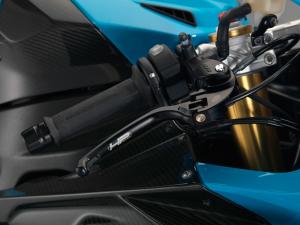
The Next Level
If the HP4 isn’t quite special enough for you – perhaps you have a Panigale S or an RSV4 Factory – BMW has several options to help set your bike apart.
Competition Package
If you want to enjoy a racer-boy appearance, order up the HP4’s Competition Package directly from the factory. It includes race-designed adjustable footpegs, a carbon fiber tank cover and bellypan, blue wheels (instead of black), and sponsor decals.
Race Kit
2013 BMW S1000RR HP4 Competition PackageOr, if you want to act the part of racer boy and want to take your HP4 into competition, BMW offers several racing accessories, including a sophisticated Software and Calibration kit (about 1100 euro) and a 2D data logger (about 600 euro). The kit features a mind-boggling array of electronic tuning options. In addition to expected fueling and ignition mapping options plus ABS, GSA and pit speed-limiter fine-tuning, the kit also offers customizable settings for engine-brake control, TC and DDC.
More amazing is how most of these settings can be optimized for particular sections of a racetrack, as the ECU is able to know where it is by logging the distance traveled. So, if you need softer damping for a small, bumpy segment of a track, just program the electronic brain to do it automatically while riding that section. Or, if you’d like a little less engine-brake control for first-gear corners, just select exactly how much you’d like on your laptop while you’re in the pits.
2013 BMW S1000RR HP4 Competition Package Front LeftBlue wheels and the sponsor sticker kit identify an HP4 equipped with the Competition Package.
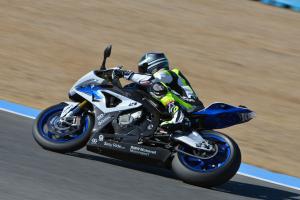
I didn’t bother to try the Rain and Sport modes, but we’re told they now provide full power instead of being neutered, with the main differences being lazier throttle response and earlier ABS and traction-control intervention. In Race Mode, I could easily feel TC and wheelie-control intrusion. The Slick setting brings sharper but manageable throttle response and an abundance of optimized TC settings able to be set on the fly: plus 7 to minus 7.
The optimized TC system might now be the industry’s finest. I first tested the neutral “0” TC setting, which I found to be about optimal for the safety margins I usually ride inside. I could feel the rear end moving around under acceleration, but I had no scary moments. Later I tried the “-2” setting, and I shouldn’t have been surprised to encounter a fairly lurid rear slide while exiting Turn 2, a tight right-hander that puts a premium on rear grip while accelerating leaned over.
By early afternoon, the HP4’s Pirelli Supercorsa SPs were getting a bit greasy from all the track thrashing, but we were lucky mid-afternoon to enjoy the additional grip from Pirelli’s new World Superbike-spec 17-inch slick tire that will be used during the 2013 season to replace the series’ 16.5-inchers. We were the only riders outside of Pirelli and the WSB grid to have sampled them.
2013 BMW S1000RR HP4 Left SideThe extra grip from the race rubber was quite noticeable, especially on corner exits. Where the SPs would regularly be squirming, the slicks hooked up and delivered stronger drives. The 17-inchers surprised many Superbike regulars during a recent test at the Aragon circuit, with several of them posting lap times 1 second quicker than the 16.5s used currently.
And speaking of rolling stock, the HP4’s lightweight forged wheels are the most noticeable upgrade when evaluated from behind the bars. The Fuchs-made wheels deliver much quicker turn-in response and make the HP4 feel smaller than the S1000RR.
2013 BMW S1000RR HP4 CorneringLighter wheels deliver quicker turn-ins, while monstrous power and Pirelli Superbike slicks enable blistering corner exits.
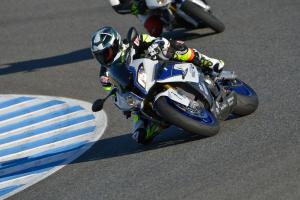
Ready For Launch
When heading out for my last session of the day, I stopped on my way out of the pits to test BMW’s new launch-control system. Just come to a stop, hold down the starter button to engage LC – you’ll see an icon lit on the instruments – then pin the throttle. Revs are held at 8000 rpm until you see the green flag – real or imaginary – and all that’s left is to control acceleration via the clutch lever. LC automatically limits torque and inhibits accel-killing wheelies, and it automatically disengages once in third gear or when leaned over for a corner.
For some weird reason, I got a big wheelie during my launch that caused me to back off the throttle, so perhaps the next-gen LC will be better. However, it must be said that no other journo who tested LC got the front end more than a few inches off the ground, so my incident seems to be an anomaly.
2013 BMW S1000RR HP4 Action FrontDuring the last session, I began to push my comfort envelope and went faster.  I was often seeing the gauges’ green light, indicating faster segment and lap times, and I began to use more TC while enjoying the bike’s sophisticated electronics. Even then, I didn’t once have a scare on the track, a strong testimony to the outright capabilities of this incredible superbike.
The HP4 nears perfection, but there’s always something to be found to bitch about when reviewing motorcycles. For this BMW, its worst behavior was exhibited when exiting Turn 4 while dialing on the power for a fast run down the back straight. There is so much power, even in third gear, that it caused the rear tire to start squirming and cause mild headshake. Not snatch-the-bars-outta-your-hands headshake, but it was a mite disconcerting and noticed by several other journos. 
2013 BMW S1000RR HP4 Thumb's UpBMW’s new HP4 encourages its rider to comfortably push his or her limits. It’s a remarkably stress-free ride considering how freakin’ potent it is.

Conclusion
The HP4 truly is a special motorcycle and a technological tour de force. Not only is it an incredibly proficient and potent sporting motorcycle, it also elevates the S1000RR platform to the exotic levels of Ducati and Aprilia – a threshold BMW’s superbike previously had difficulty achieving. The RR’s prestige level has been amplified after taking several victories in World Supers this year, and the HP4 technologically raises the performance bar.
Other than the trifling instability issue we noted at Jerez (and not present on the many other tracks we’ve ridden on with the S1000), the only problem I see with the HP4 is affording it. BMW has yet to set prices for the HP4, but we’re expecting an MSRP at or above 20 grand, slightly undercutting the premium Italian brands. UPDATE: Price details can be seen in this news post.
That’s not cheap, but it seems like a relative bargain for what might be the most capable sportbike ever built. Expect them at dealers this December.
Duke's Duds
2013 BMW S1000RR HP4 Gear
  • Helmet: Bell RS-1 with SOLFX Transitions faceshield
  • Leathers: Alpinestars Racing Replica
  • Gloves: Alpinestars GP Pro
  • Boots: Alpinestars Supertech R

BMW C 600 Sport 2012 Review

BMW is hitting the scooter segment hard and heavy with the all-new C 650 GT luxury scooter and the C 600 Sport maxi sportster that will change the way you think about scooters.
The massively impressive thing about the BMW C 600 Sport is how stable the chassis is at high speed, I mean, this is a scooter but it has got high-speed stability like a motorcycle. Its 647cc inline-two-cylinder engine has enough power to propel it to speeds in excess of its 112-mph electronic governor. The engines in both C-class scooters allegedly develop 60 horsepower at 7500rpm and 48.7 ft-lb of torque at 6000 rpm when rated at their crankshafts. (We expect about 50 horses at the wheel – Ed.)


Riding a scooter in a big city like Madrid always means you’re first at each traffic light. The variable-ratio automatic transmission provides steady progress, but full throttle works best when sprints are needed to stay ahead of traffic. Things start to happen faster around 3000 rpm, but I would have preferred torque to have spun up quicker for an even faster reaction from a stand-still. Once underway there was ample response from the two-cylinder engine.

The C 600’s exceptional stability also pays off through fast, sweeping corners where normal scooters usually try to tie themselves into knots. This gives lots of confidence and the ability to carry lots of speed into and through the corners. The suspension is very firm for a scooter, so there’s none of that wobbly feel through corners or when braking hard.
2012 BMW C 600 Sport
2012 BMW C 600 Sport Flexcase underseat storage
ABS brakes come as standard, and BMW uses two 270mm discs up front. This should be enough in theory, but let’s not forget that the C 600 Sport weighs in at a porky 549 lbs and hence the brakes are not the strongest aspect of the new BMW scooters. I had no problems braking hard when mountain riding, but the binders have a lack of feedback and feel a bit spongy. No worries at all about safety; I just wanted stronger brakes or less bulk.
The seat is taller and narrower than the luxury sofa found on the 650GT. This is to emphasise the sportiness and additional sharper handling abilities of the Sport. It is still comfortable but not in the same league as the GT. The sportier seat gives more freedom to move about, and that’s the whole point with the C 600 Sport.
Under the seat is a relatively large storage compartment and something BMW calls Flexcase which enables additional storage space for an extra full-face helmet when the scooter is parked. An expandable membrane is responsible for the extra space, but this can only be used when parked (as the case touches the rear wheel when expanded), and the engine will not start when the flexcase is deployed. Two open-faced helmets can fit without expanding the Flexcase if they’re on the small side. It will easily swallow a big shopping bag and a full-faced helmet.
Due to the 70-degree forward inclination of BMW’s new parallel-Twin engine, the whole package is very flat but not flat enough to completely flatten out the area between the rider’s legs. BMW should have added a hook underneath the ignition key as seen on many scooters, as this would allow for a small bag or additional helmet to be carried should you have used the underseat compartment for something else.
2012 BMW C 600 Sport left side
The engine works as a load-bearing chassis element in conjunction with the tubular-steel bridge frame. Along with the transmission, the powerplant is quite a hefty unit weighing in at nearly 180 lbs in total. The scooter has a single-sided swingarm made of aluminum, but its large size looks anything but light.
The 31.9-inch seat height is 30mm taller than on the GT, which I feel already was a little bit too tall for this segment. At 6-feet tall, I’m just big enough to sit comfortably and have my feet straight on the ground at a standstill. Somebody shorter may have to lean to either side, and then the considerable weight of the whole thing comes into play. Should you do a tight turn around on a hill and make a mistake such as not using enough throttle, the scooter could easily succumb to gravity.
2012 BMW C 600 Sport right profile
The sporty part of the Sport is brilliant. I have never enjoyed riding a scooter fast this much – it’s very close in enjoyment to riding a full-on 600cc motorcycle through the corners. As soon as that 647cc engine is spinning, there is lots of torque giving good corner exit speed. Due to the automatic transmission, you do ride differently to a motorbike, particularly mid-corner where you often have to let go completely of the throttle. It gives a peculiar feeling of cruising through mid-corner when in reality you are going as fast as you possibly can. You can’t use the engine to control speed, basically, and the brakes have to be used when you wouldn’t on a motorcycle. The nature of the CVT transmission makes the engine work in a reactive rather than progressive way.
2012 BMW C 600 Sport displayThe C 600 Sport wears Pirelli Diablo Scooter tires in dimensions 120/70-15 front and 160/60-15 rear. The width and profile is the same dimension as on most motorcycles but are on 15-inch aluminium wheels rather than 17-inchers.
The instrument console has a modern feel, and even revs are showed in a small digital graphic. There’s plenty of information, and I particularly enjoyed the outdoor temperature and miles per gallon feature. At top speed it showed around 5.1 litres per 100km (46 mpg), which isn’t bad at all considering the high speed with the windscreen in its upper position. The fuel tank takes 4.23 gallons, and BMW’s solution in opening the fuel tank cap is very clever as you just push the ignition key and switch left to open it. Do the same towards the right and the seat opens. This enables you to stop at the petrol station and open the fuel cap without having to move.
The Sport’s three-position windscreen is only manually adjustable, and you can’t really do this whilst riding. The windshield on the C650GT is much more protective and is electrically adjustable. The Sport’s fairing is lighter and sleeker. Our test models had the sporty Cosmic blue metallic paint. Other options are the black metallic and silver metallic, which doesn’t complement the sporty look of the 600 quite as much as the blue.
2012 BMW C 600 Sport
Conclusion
BMW has done a very good job in creating its first bona fide scooter. Forget about the roof-equipped C1, as that was a bit of a crazy concept. The C 600 Sport is a proper scooter, BMW style. It’s very fast through corners and also outright on the motorway, with great stability only really found on motorcycles. The footboards that allow both sporty riding and a stretched cruising position is a great feature, and the Flexcase is another ingenious invention that adds to the practicality of the 600 Sport.
However, the C 600 Sport is a heavy machine for a scooter, and because of this its braking performance suffers. And, for some riders, its seat is a little too tall. The BMW C 600 Sport is a great scooter, but it’s not perfect.
Ed again - the C 600 Sport isn’t expected to hit U.S. dealers until this fall, arriving as 2013 models. Pricing hasn’t yet been announced, but we're expecting an MSRP around $10,000.
2012 BMW C 600 Sport
Highs:   Lows:
  • High-speed stability
  • Powerful twin-cylinder engine
  • Practical
  • 549 pounds is too heavy for a Sport scooter
  • Seat height could be a major obstacle for some
  • Braking power is only adequate


BMW R1250GS 2013 Review

Big news is leaking out from Bavaria. The next BMW GS is undergoing final testing, and the successor to the company’s best-selling model, the R1200GS, will be powered by the first liquid-cooled Boxer-Twin engine ever!
Look closely and you’ll see the addition of radiators hidden under air shrouds – a dead giveaway that the new engine is liquid-cooled. This is huge news considering the air-cooled Boxer has been a BMW staple for almost 90 years.
Liquid-cooling allows a quicker warm-up time, reducing critical post-start-up emissions, while also lowering operating temps. This will help achieve stricter Euro 5 standards slated to begin in 2015. Liquid-cooling also enables increases in power, so along with a bump in displacement to around 1250cc, we expect a bump in power to compete against the latest batch of challengers to the adventure-touring throne.


The R1250GS engine is an all-new design, sharing no common parts with its predecessor. It’s also carried higher in the frame, increasing its ground clearance. It’ll be interesting to see how this affects handling.
2013 BMW R1250GS Left RearAlso different on the new engine is the orientation of the cylinder heads. Now rotated 90 degrees forward, throttle bodies are situated above the combustion chambers while the exhaust exits from underneath the cylinder heads instead of from the front. We predict exhaust shields to be among the first of the aftermarket accessories to be offered.
Chassis differences and modifications aren’t as noteworthy as those seen in the engine bay. The frame is steel and looks similar to the one it replaces, as does the Telelever front and Paralever rear suspensions.
Front braking is enhanced with the use of radial-mount front brake calipers. ABS will be standard equipment, as evidenced by the wheel-speed ring on the front wheel, which will undoubtedly play a role in a new traction-control system. We also expect an updated form of BMW’s ESA electronic suspension adjustment.
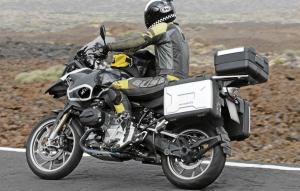
2013 BMW R1250GS Spy PhotoThis will certainly be the most powerful GS ever. The switch to liquid cooling may also alienate some of BMW’s core customers.

A new transmission sends the Boxer’s power through a shaft drive now on the left side, forcing the exhaust to now terminate on the right side of the bike. The rear tire appears wider, up from 150mm to handle a bigger load capacity. A staggered headlight remains, now with an LED running light. These pictures would indicate the large fuel tank hasn’t gone anywhere, and neither have the spacious saddlebags.
Life at the top was nice for the BMW R1200GS line. As BMW’s best-selling model worldwide, the air-cooled, horizontally opposed Boxer-Twin engine is loved by many for its quirks, and the bike’s jack-of-all-trades attitude has endeared it to fans worldwide.
2013 BMW R1250GS Spy ShotA considerable amount of saddlebag volume is stolen by the new GS's rectangular-shaped muffler.
Then again, its success could partially be attributed to the fact that there really hasn’t been anything else like it. Not anymore; with motorcycles like the Ducati Multistrada 1200, Yamaha Super Tenere and the upcoming Triumph Tiger Explorer all looking to share — if not hog — a piece of the adventure-touring segment pie, BMW has reacted.
BMW still hasn’t officially recognized this bike or these photos, but clearly the company has been working hard at beefing up its most iconic model. It will be interesting to see how it compares with the GS we already know – and how the air-cooled GS devotees react to comprehensive changes to their icon.

BMW G650GS Sertao 2012 Review

BMW has a well-deserved reputation as a maker of rugged, all-terrain-conquering motorcycles that also serve as capable, good-mannered street machines. These days the bike that fills that image in most motorcyclists’ minds is the R1200GS. And for good reason: the big GS (and up-spec Adventure model) is a sales volume leader for the venerable German motorcycle manufacturer.
But the success of BMW’s two-wheeled adventuring ways doesn’t result solely from the glory-grabbing 1200GS or even the successful F800GS. There’s a humbler member of the Beemer family that’s contributed substantially to raising the profile of the GS lineup of motorcycles.


The 650GS Sertão: Even More GS in the Littlest GS
Modestly appointed by comparison to the 1200, the G650GS – powered by a 652cc Single – has been the first step into GS-land for lots of riders, starting way back in 1993 when this single-cylinder, chain final-drive (a serious break from the traditional BMW twin-cylinder platform at the time) was first born as the F650 Funduro.
For 2012 BMW has amped up the GS portion of the G650GS Kevin Duke recently reviewed, by creating a more off-road inclined stablemate, the G650GS Sertão. Named after the dry, hot region in Northeastern Brazil of the same name, BMW wanted to re-infuse the current 650 with the same adventurous spirit it gave to the F650GS in 2000 when the F650GS Dakar was crafted in honor of BMW’s successes in the Paris-Dakar Rally. BMW says the Sertão is the new Dakar.


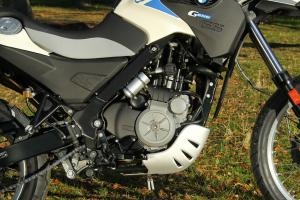
2012 BMW G650GS Sertao engineThe Sertão retains the same frame, brakes, instrumentation and 652cc Single from the standard 650GS. But giving the Sertão greater advantage in unpaved environments is: 8.3 inches of suspension travel (nearly 2 inches more than standard), spoked wheels (21-inch in front), hand guards, a 5.0-inch taller windscreen, steel lower engine guard and a 33.9-inch seat height (2.4-inch increase). A fork brace was added and the lower/inner fender removed, while the 1200GS-esque upper fender beak is a tad longer. And, for those counting, the Sertão’s 426-lbs wet weight is 4.0-lbs more than the standard G650GS.
While the standard G650GS is a known quantity to us on the street, BMW invited the moto media to a day of mixed riding environments to sample the Sertão. The day-ride started at the now famous and successful RawHyde Adventures riding school located near Castaic, Calif.
RawHyde focuses almost exclusively on creating anew, or improving upon, the off-road riding talents of motorcyclists, catering especially to BMW GS owners. Founder and proprietor, Jim Hyde, created the school in 2000 initially as a dirt bike/dual-sport training camp, but over the years Hyde discovered that within the GS community few owners of the world-traveling Beemer possessed the skills necessary to allow them to fully unleash the potential of the GS.
After years of successfully teaching off-road and adventure-type riding to the GS community, RawHyde became an official BMW training facility in 2008 – one of only nine BMW-endorsed schools in the world. Known as the BMW Off-Road Academy, RawHyde offers three levels of adventure-riding training, as well as a number of multi-day excursions, including the Continental Divide Ride – a nine-day journey along the spine of the Divide.
Hyde and his team have competed in the Dakar Rally, and plan to do so again in the 2012 event.
2012 BMW G650GS Sertao Action rightThe elements and features that make the Sertao better suited than the standard G650GS for off-roading don’t come at the cost of impeding the Sertao’s on-road performance.
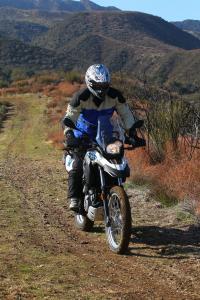
Hyde knows the capabilities of the G650GS, as well as the mountainous areas around his facility. A route that included miles of sometimes rough and rutted Jeep-type trails with numerous shallow water crossings along the way proved the proper dirty mixture to go along with plenty of paved-surface riding.
Adventure Worthy
In his review of the standard 650, Kevin refers to the bike as having a “highly cooperative chassis that presents no surprises,” which is aided by a wide, one-piece handlebar providing good steering leverage for “knife-like agility” when dicing up corners. These qualities remain in the Sertão. And despite its additional suspension travel, the front-end doesn’t dive excessively under braking.
Damping in the Sertão’s new long-travel sticks was ideal both on and off-road – impressive considering the fork lacks adjusters – while the 8-plus inches of travel smoothed out even the biggest ruts and rocks I encountered. Good suspension aside, 426 lbs is hefty by dirt bike standards. Yet that streetbike-sized figure didn’t prove a significant hindrance on the trails – the humble engine has the power to pull the bike’s weight out of greasy mud holes or up and over steep inclines, as evidenced by a handful of more daring journos’ antics during the day.
Further impressive, the Sertão’s street-biased Metzeler Tourance tires didn’t prove a serious disadvantage while off-road.


The G650 Thumper is counterbalanced to offset vibration inherent in a single-cylinder engine architecture. At speeds upwards of 80 mph the amount of engine vibes reaching the Sertão rider are minimal – a welcome trait when droning down the interstate.  A flat, plentiful torque curve (44.2 ft-lbs at 7200 rpm as tested) means useful grunt early in the rev range with plenty of pulling power elsewhere, even when lugging along in higher gears.
However, despite near ideal gear ratios for street riding, I found myself wishing first gear had an even lower ratio than it already does when it came to picking my way through tighter, more technical off-road sections.  The sometimes-finicky clutch combined with how quickly the bike can pull away in first gear made it challenging to finesse my way through portions of terrain that demanded near-crawling speeds.
2012 BMW G650GS Sertao Action dirtTo better enable slow speed maneuvering, first gear in the R1200GS Adventure is 10% shorter than first gear in the standard GS. I’d like to have seen a similar move made here between the Sertão and standard G650GS. However, this is nit picking and by no means a deal-breaker for the new G-GS. Clutch effort is notably light ­ albeit with a too-early engagement for my preferences ­ and the 5-speed trans clicks without a hitch.
A caveat to thoughtful riders says you may want to reposition the shift lever in order to get the toe of bulky motocross-style boots underneath the shift peg for less cumbersome upshifts.
Kevin admired the standard 650’s ergos, noting that its 30.7-inch seat height creates an environment welcoming of riders of shorter stature, especially for a bike with 6.5 inches of travel. The Sertão’s off-road biased suspension creates a seat height far less welcoming of short folks, and you won’t find a low seat option for the Sertão as you will for the standard 650GS. However, there is an optional tall seat (35.4 inches, $239).
2012 BMW G650GS Sertao waterThe Sertao doesn’t let a little water get in the way of adventure.

I’m not the tallest geezer around, but even with my 30-inch inseam I found the Sertão’s seat height manageable when it came time to dismount or put a boot down during a stop – on and off-road. Additionally, the seat’s width and foam density made it a comfortable place to rest when I wasn’t standing on the footpegs (which offer the added convenience of a removable vibration-damping rubber insert).
Another add-on that may seem pricey when you don’t need it, but soon becomes worth its weight in gold when you do, is the heated grips option. Portions of the ride took us to elevations that saw several inches of fallen snow and near-freezing temps. On the high setting the grips produced enough heat to keep my winter-gloved hands feeling borderline hot. During the frigid route section I realized I would’ve gladly craigslisted something of value in order to have the factory-installed heated grips ($319 if purchased separately) on a Sertão I owned.
The new 650GS’s tall-ish windscreen is a genuine advantage in any scenario, since it offers increased wind deflection while bombing down the freeway, as well as providing some additional protection from debris kicked up by other riders when venturing off the beaten path.
2012 BMW G650GS Sertao rightThe new Sertão lives up to the GS heritage from which it was born.

Although numerous evolutionary changes to this BMW model over the past 19 years have given us the G650GS we know today, it has nevertheless remained at its core an approachable but highly capable motorcycle from BMW.
The Sertão is worthy of its GS badging.
Look for the G650GS Sertão in dealers in January 2012 with a base MSRP of $8650, or $8950 with the heated grips and power socket package.


BMW S1000RR 2012 Review


That BMW is a company with huge engineering resources shouldn’t be a surprise to anyone. After all, it’s been building motor vehicles for more than 90 years and has a German stereotype to uphold.
Nevertheless, my biggest surprise at the launch of the 2012 S1000RR was the boundless enthusiasm each engineer, no matter if gray hair or no hair, showed in regard to sportbikes. There’s a lot more to this performance-driven crew than just building transportation appliances, as we found out at the Ricardo Tormo circuit in Valencia, Spain, where the bike’s 2012 edition was sampled by the world’s media last week.


These sportbike enthusiasts are responsible for the overhaul of our 2010 Motorcycle of the Year just two years after first blowing our minds at its first press launch. No other literbike has such an accelerated pace of development.
Sure, this latest version has only seemingly modest refinements, but, as the aforementioned Poschner told us, “It’s definitely more than just a facelift.”
The Walk-around
The RR’s appearance is mostly familiar, with its most notable revision a tidier tailsection with new ventilation ducts. Trainspotter-types will notice new aperture grill venting near the top sides of the fuel tank and the addition of aerodynamic winglets on the sides of the nose fairing.
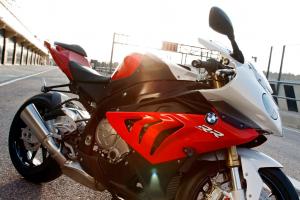
2012 BMW S1000RROutwardly, our test bikes were outfitted with a new Racing Red and Alpine White color combo that looks fresh. Also in attendance were a few RR’s in a new Bluefire color that just needs some Rizla decals to mimic the Suzuki MotoGP bikes. Returning for another go-‘round is the classy four-color BMW Motorsports scheme, as well as a Sapphire black metallic version that substitutes a black-anodized swingarm in place of the raw aluminum finish on the others. 
More Than Skin Deep
It’s the changes under the Double-R’s skin where BMW’s engineers flexed their muscles. Schwickerath told us his goal was to increase agility while keeping stability and traction on the same levels. So a similar but new frame was cast, now with larger air intakes and a slightly higher swingarm pivot location.
2012 BMW S1000RRThe frame change plus a shorter rear shock, less fork offset and fork tubes held 5mm higher in the triple clamps result in a rake angle 0.1-degree lazier at 24.0 degree and 2.5mm of additional trail to 98.5mm. These minute changes can result in marginally heavier steering, but this is balanced by a 10mm wheelbase reduction to 56.0 inches and a slightly higher center of gravity. A slipperier steering head bearing also reduces effort at the bars.
Suspenders Animation
The RR’s 46mm inverted fork and single shock appear outwardly similar (except for the red shock spring), but internal changes abound. BMW claims minimized internal friction at both ends for additional responsiveness.
The fork now features a mid-speed damping valve that builds up compression damping with greater precision, and the damping adjusters now operate in a more linear fashion – previously, there was a wide variance in positions 1 to 5, with smaller increments between 6 and 10.
Meanwhile, the diameter of the shock’s piston rod has been increased to allow more oil to flow through the low/mid-speed valve, and, combined with revised needle geometry, results in a linear buildup of damping force. A new check valve completely separates the influence of rebound damping on the compression damping.
Let’s Ride!
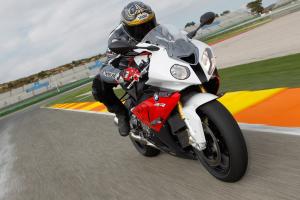
2012 BMW S1000RRAs it was my first time at the Valencia GP circuit, I agreed to the recommendation of starting off in the RR’s Rain mode instead of the more powerful Sport, Race or Slick selections. New for 2012, the Rain setting now boosts maximum power to 163 crankshaft ponies, a bump of 11 horses, which felt plenty adequate while navigating a new track. However, the Rain mode also has a more intrusive traction-control calibration and restricts power while leaned over past 38 degrees, so on the third lap I switched to Sport.
Now with its massive 180-rear-wheel-horsepower on tap, the S1000 rocketed down Valencia’s front straight. A shorter-turn throttle and lighter throttle spring gives quicker access to full power, augmented by using the same throttle curve as Race and Slick modes (previously four separate curves). The 20% larger air intakes, repositioned exhaust catalyzers and revised ECU tuning are said to improve power production between 5000 and 7500 rpm, but all I could discern is this is still the fastest literbike in any straight line!
2012 BMW S1000RRBMW’s S1000RR is still the quickest literbike down a straightaway.

Trackday junkies will still find the electronic settings in Sport mode not liberal enough. Throttle application is restricted when leaned over past 45 degrees, which is still well within the adhesion levels of the Metzeler K3 Racetecs. Sport mode also limits wheelies, which, on a sportbike this powerful, is a regular occurrence. However, the wheelie-control system is now less herky-jerky. It has the same thresholds for the four modes, but revised calibration results in a slower reapplication of power after ECU brings down the front wheel.
When I wasn’t thinking about electronics, I was enjoying what seemed to be marginally quicker steering response. Although still not with the class-leading agility of a CBR1000RR, BMW’s RR is easily coaxed into a lean and feels composed in corners.
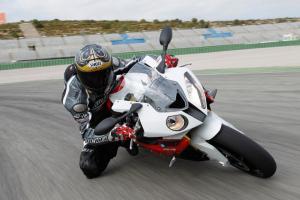
2012 BMW S1000RRGetting down on one knee to prey.

Race Face
Next up was the Race setting which has higher limits than most non-racers – a rider will need more than 48 degrees of lean before throttle application is affected, which is a steeper angle than most riders comfortably achieve. This higher-performance setting also allows higher wheelies before power is reduced to bring them down.
And with the explosive clout from the RR’s potent powerplant, wheelies happen frequently, even more so on the 2012 model because of its lower gearing via an additional tooth on the rear sprocket, which plays a part in the 10mm wheelbase reduction. The front end dances upward even in fourth gear at 135 mph, making me glad the newly adjustable steering damper was set to position 8 of 10 to keep the pucker factor down.
2012 BMW S1000RRThe S1000 nudges 160 mph on the front straight before a rider needs to bleed off speed for Turn 1. Pushing my braking point a bit later, I hammered the powerful Brembos and was met with some ABS intervention through the front lever as the rear wheel was lifting off the ground, which is as the Race ABS intends in Race mode. Its unexpectedness caused a bit of a fright, but it’s a condition that can be averted by switching to the ultra-performance Slick mode or disabling the ABS.
A Weighty Solution
Little known fact: In 2009, during its inaugural season in World Superbike competition, BMW was having difficulties getting the S1000RR to hook up when driving out of corners. So, seven months after beginning series production of the S1000, BMW added approximately a pound of weight to its crankshaft with the intent of enhancing driveability of the WSB weapon. BMW engineers tell us not much difference could be felt on the streetbike, but it did aid the racebike, which has to use a stock crankshaft.

Slick Is Quick
Slick mode allows fast riders to push the machine’s limits, allowing up to a dizzying 53 degrees of lean angle before throttle application intervention, and the traction-control setting permits a fair amount of rear-tire drift to help steer the bike during corner exits. And intervention from the TC is smooth despite considerable rear slip. The DTC is reassuring and really aids confidence on corner exits. If you’re especially brave, DTC can be disabled with a long push of a single button. It’s worth noting here that not one of the S1000RRs hit the deck due to a loss in traction.
The heady mill in the RR provided bigger thrills during bigger and longer wheelies (up to 5 secs), and the awesome acceleration was enhanced by BMW’s optional quickshifter that allows full-throttle, clutchless upshifts an instant before smacking into a 14,200-rpm rev limiter. The bike’s voracity for inhaling straightaways is absolutely mind-bending for anyone not racing a Superbike.
2012 BMW S1000RRAfter getting accustomed to riding near the speed of light, I finally had a chance to notice the revised instrumentation. The prominently placed analog tach has larger numbers on its white face for easier reading, augmented by the returning white shift light. The LCD info screen can now be set of one of five brightness displays. Also new is a “best lap in progress” indicator that responds every 100 meters to tell a rider if he’s on a pace quicker than the previous quickest lap.
In the corners, it’s difficult to say for certain if the new RR has the improved steering accuracy and feedback promised via its chassis changes, but I honestly had zero quibbles about its responsiveness and precision. It obediently goes where it’s pointed, and it feels stable and communicative when carving around an apex. Also commendable was the non-existence of major setup issues, as all the riders I polled weren’t bothering to mess with significant suspension adjustments.
2012 BMW S1000RRPicking a precise line is easy on the S1000RR.

The Verdict
Well, since BMW’s uber-bike was already a standout in its class, it shouldn’t be a surprise to find out this slightly improved model gets a very high rating. The class-dominating S1000RR is now even more potent and usable for 2012. And after getting to know the engineering and testing brain trust behind the RR, I’m fully confident they’ll never take a backward step.
Pricing has yet to be determined, but with the aggressive MSRP of the previous version ($13,950 base) and continual elevation of prices among the Japanese competition, the S1000RR might be a relative bargain. After all, how many thousands would you have to spend to get another 30 hp from a Yamaha R1…?
2012 BMW S1000RROur experience on the 2012 BMW S1000RR tells us that the uphill literbike struggle for its rivals just got a little steeper.

 
Design by Wordpress Theme | Bloggerized by Free Blogger Templates | coupon codes