Showing posts with label Triumph Reviews. Show all posts

Wednesday, May 15, 2013

Triumph Scrambler 2012 Review

Triumph’s Scrambler proved to be difficult to review. Judged against other machines in its $8799 price range, it’s kind of slow, a little heavy, and excels at nothing except being cool. In purely objective terms, it’s a mediocre motorcycle.
However, as we racked up seat time, the retro ride began to charm us in ways no other bike could. There isn’t another motorcycle on the market that has the Scrambler’s blend of nostalgia, versatility and general competence.


History
Triumph understands that nostalgia has a way of prying open wallets. The Hinckley-built Bonneville re-creations began rolling off production lines in 2000 using a fresh parallel-Twin engine design displacing 790cc. Since then, Triumph has built 147,000 of the twin-cylinder bikes that include the Bonneville variants, Thruxton, America, Speedmaster and the Scrambler, representing about 25% of Hinckley’s total production.
The Scrambler was launched in 2006, inspired by the late-1960s TR6C Trophy that featured a similar high-mount exhaust system but located on the bike’s left side. Its engine, now upped to an 865cc displacement, features a 270-degree crankshaft instead of the Bonnie’s typical 360-degree spacing to emulate the power pulses of a V-Twin engine. It’s a similar configuration to the America and Speedmaster cruisers. Carburetors gave way to fuel injection in 2009, with the throttle bodies cleverly disguised as old-school carbs.
2012 Triumph ScramblerThe Scrambler is an elemental motorcycle that harkens back to simpler times.
The Scrambler receives several other modifications to distinguish it from Triumph’s other air/oil-cooled models in an attempt to give it some authentic 1960s desert sled appeal. In addition to the Scrambler’s revised engine and high-mount exhaust, it also receives longer-travel suspension, fork gaiters, spoke wheels and tires with large tread blocks.
The King of Cool
Steve McQueen is an iconic figure revered by millions, but especially by middle-aged motorcycle enthusiasts. As an actor, he ignited the screen with performances in legendary films such as The Magnificent Seven, Bullitt, Papillon and the original The Thomas Crown Affair. In 1974 McQueen became Hollywood’s highest-paid actor when he co-starred with Paul Newman in The Towering Inferno.
Steve McQueen King of Cool print T-ShirtTriumph recognizes the enduring appeal of Steve McQueen and offers a few apparel items authorized by the McQueen estate. Seen here is the McQueen T, a 100% cotton shirt with embroidery on back that references the address on Hollywood Boulevard on which his Walk of Fame star is located. The chest has a "King of Cool" print, while the right sleeve has a McQueen signature and his racing number (278). Like anything connected to the King of Cool (a pair of his Persol sunglasses sold at auction for $70,200), it ain’t cheap, with a list price of $39.99.
But McQueen earned maximum credibility among riders for two films in particular. The Great Escape starred McQueen as Virgil Hilts, an American Air Force captain imprisoned in a German POW camp. The 1963 film is capped off with an escaping Hilts trying to evade recapture by stealing a German motorcycle and ditching his pursuers, climaxing with a glorious but unsuccessful jump over a barbed wire fence to neutral Swiss territory.
While any two-wheel fan can get excited by a motorcycle chase, what made this one special was the fact that McQueen did almost all of the stunt work himself, even doubling as German soldiers giving chase to his own character thanks to shrewd editing! McQueen’s best pal, Bud Ekins, stood in for the star during the famous jump scene, apparently because the film’s insurance company barred him from doing it himself.
Of note, the motorcycles chosen for the stunt work were not German BMWs as would be historically accurate. Instead, McQueen specified a military-spec Triumph TR6, a progenitor to the Scrambler tested here. And one year later, McQueen represented America in the 1964 International Six Days Trials on a Triumph.
Steve McQueen McQueen kicking over one of his Triumph desert sleds.
McQueen also played a pivotal role in the seminal motorcycle movie, On Any Sunday, financing it via his Solar Productions company. He also played a prominent on-screen role, featuring as a competitor in the Elsinore Grand Prix under the pseudonym of Harvey Mushman, as well as in the film’s memorable closing scene riding on a California beach with dirt-tracker Mert Lawwill and off-road legend Malcolm Smith.
The King of Cool’s time with us lasted just 50 years, as the Hollywood legend succumbed to cancer in 1980. But his legend lives on …
2012 Triumph Scrambler Duke dreaming he was even half as cool as McQueen.
First Impressions
As mentioned in the intro, objectively reviewing the Scrambler is confounding. Like a cruiser, it is a slave to fashion. The headers of those cool-looking high pipes rub up against a rider’s leg, and the vintage-y dual shocks are lacking sufficient damping control. Its front tire squirms on longitudinal road seams, and its flat-as-an-ironing-board seat feels so very odd to an ass accustomed to modern, sculpted saddles.
But it surely looks like an authentic desert sled, subtly accented by the matte khaki paint color. It regularly draws in second glances by people who recognize Triumph’s rich heritage, even if they’re only casual observers.
“If I bought a bike, I’d buy a Triumph,” said one 40-ish passerby as I parked the Scrambler. “Or a Harley,” he added, which reveals the shallow depth of his motorcycle knowledge but gives an indication of how much pull the Triumph brand has maintained over the decades.
2012 Triumph ScramblerDuke pretending to be McQueen writing home about his performance in the Elsinore GP. The jacket worn in these photos is the McQueen 2 that is inspired by the togs worn by McQueen during the ISDT. The 600-denier Bristex shell is bonded to a waterproof and breathable Tri-Tex membrane, augmented by CE-approved armor and a removable quilted liner. Retailing from Triumph for $249.99, it features the company’s logo on the left chest and a faint McQueen signature on the left arm. We like that it’s reasonably protective while being unobtrusive enough for casual wear.
The Scrambler’s 32.5-inch seat height might be a stretch for some, and a right-leg’s direct reach for the ground is spoiled by the headers intruding on inner knee space. A right leg is constantly in contact with the headers’ shielding – short-pants riders beware! – but the guards do a commendable job of isolating radiant heat to several degrees shy of uncomfortably hot. The headers look like they could’ve been placed further inward but at the risk of heating up the fuel system’s throttle bodies.
Aside from the exhaust issue, the roomy rider ergonomics were judged to be quite agreeable by our test riders, no matter their size. The handlebar position demands more forward rotation than expected from an off-road-ish design, but it still yields an open rider triangle. Footpegs are located about where some of us would like to place their feet at a stop. Tall, period-looking round mirrors offer an unimpeded view rearward. Both hand levers are adjustable for reach.
2012 Triumph Scrambler gaugesThe Scrambler is fitted with dual gauges framed by chrome bezels. The LCD odo/clock is a giveaway they’re not vintage Smiths.
Triumph’s 865cc Twin benefits from fuel injection, but it’s a step behind the latest systems. The throttle bodies have a pull-out knob for richening the fuel mixture during cold-weather starts, and throttle response can be a bit abrupt from closed throttle. Worse, our tester would occasionally exhibit a cough off idle when leaving stop lights.
Although power can’t be called abundant, its flat torque curve and loping nature delivers adequate grunt unless you’re at a track or running from the law. Unlike many motorcycle engines, the Scrambler delivers power all the way throughout its rev range, so there’s no need to rev it out for adequate thrust. Its linear power delivery is especially evident when carting around a passenger, as it enables a rider to be ultra-smooth. The flat seat permits your pillion to comfortably snuggle up behind you.

The torque-rich powerplant enables easy getaways from a stop despite the clutch’s narrow and poorly defined engagement zone. A long first gear is handy around town, and the short-throw, 5-speed gearbox is a pleasure to row through. At first we wished for a sixth gear, but fifth proved to be just fine even at 80-mph cruising speeds.
With a fueled-up curb weight of 506 pounds, the Scrambler is by no means a lightweight, but it comports itself well in urban use despite a lazyish 27.8-degree rake and moderately lengthy 59.0-inch wheelbase. Its 19-inch front wheel creates a minor flop effect at parking-lot velocities, but low-speed turn-in response is pleasingly quick. However, the large (and heavy) front wheel slows responses at elevated speeds and during side-to-side transitions.
“It’s a supremely easy bike to ride around town or for short jaunts on the weekend down your favorite local road,” comments Tom Roderick.2012 Triumph Scrambler The Scrambler’s brakes are a massive upgrade from those on the Meriden-built Triumphs of yore. Although using just a single disc at both ends, the rotors are relatively huge at 310mm in front and 255mm at the rear, both clamped by two-piston Nissin calipers. Each provides a nicely firm lever feel. If there’s a fault, it’s that the rear is fairly easy to lock because of a large brake disc and low-grip tire.
Suspension is about what you’d expect from a modern interpretation of a classic. The 41mm Kayaba fork is non-adjustable but performs well enough over its 4.7 inches of travel. The period-looking dual Kayaba shocks out back exhibit a period-feeling lack of damping that can deliver a jouncy ride. Preload adjustability can accommodate various loads over 4.2 inches of travel.
2012 Triumph Scrambler The Scrambler emulates the desert sleds of the 1960s, but you’ll want to keep your off-road adventures fairly mild.
Highway travel on the Scrambler is tolerable rather than exemplary. Its tallish bar positioning and lack of wind protection turns a rider into a human sail at elevated speeds, and longitudinal pavement grooves can influence a squirmy effect on the front tire that feels like (but probably isn’t) frame flex.
The engine’s mild tuning and power delivery results in fuel economy numbers that are higher than we typically get from our heavy throttle hands. It averaged nearly 45 mpg during its time with us, and we bet most riders will be able to eke out 50-plus mpg stints. With its 4.2-gallon tank, fuel stops can reach 200 miles apart.
We all appreciated the many vintage-y design elements of the Scrambler. Its tank is highlighted by the classic harmonica-style Triumph badge and old-school knee pads, and the bullet-shaped turn signal lamps made us feel nostalgic. We also felt nostalgic when we went looking for a helmet lock that doesn’t exist. “I can excuse not having a helmet lock on a lot of modern motorcycles, but such an item is requisite on a pseudo-vintage bike such as this,” Roderick flamed.
The high-mount exhaust system is reminiscent of something from the 1960s, and its unique design is visually impressive. However, 21st-century exhaust emissions regulations force it to be large and heavy. Anyone coveting stealth will appreciate its dulcet tones, but we believe it’s a little too nice for our ears. Roderick described it as sounding like a fart in a bathtub.
2012 Triumph Scrambler with Accessory ExhaustIf we had a Scrambler in our garage, it would certainly be fitted with this beautiful and much less cumbersome looking Arrow exhaust system. Yours for $1,099 from Triumph.
Conclusion
So, the Scrambler is a vexing proposition. It rates poorly if you’re a looking for the ultimate in performance for the dollar. However, the Scrambler also proved to be irresistible. It packs in an amount of coolness no modern design can achieve.
“The Scrambler certainly owns the look of the old-school scramblers of yore,” says Roderick. “Engine, braking and handling performance are all commensurate with the type bike the Scrambler represents. In other words, it's a modern bike whose looks and performance aren't much better than the models it meant to emulate. However, the chances of it breaking down and leaving you stranded are relatively remote. It’s a great blank canvas for a motivated enthusiast to manipulate into a one-off custom of his own design.”
So, if the allure of a vintage Triumph tugs at your heartstrings, you’re likely to be enthralled with the Scrambler. There is simple nothing else quite like it.
“It emits a Steve McQueen cool,” Roderick observes. “Just don't try jumping any barbed-wire fences with it.”
2012 Triumph Scrambler Reliving dreams of a bygone era costs $8,799.

Triumph Street Triple R 2013 Review

Triumph’s Street Triple platform is one of our favorite motorcycles because of its playfully sporting character that appeals to all sorts of riders. In fact, the up-spec R version took our Motorcycle of the Year honors in 2009. So when we learned about an updated version for 2013, we were hoping Triumph didn’t do anything to diminish its eminently likeable qualities.
Measured by the sum of their parts, the 2013 Triumph Street Triple and Street Triple R are more than warmed up 2012 leftovers. The lauded 675cc inline three-cylinder returns unchanged, but the obvious relocation of its exhaust system is only the tip of the proverbial iceberg. From frame to wheels nearly everything besides the motor powering these naked hooligans must be preempted with the word “new.”
To begin, not only is the reengineered exhaust system 7.9 pounds lighter than the one it’s replacing, the weight is centralized closer to the engine to make quick transitions even quicker. Also helping the S3R’s improved flickability is a lighter by 1.1 pound rear wheel, 1.1-pound lighter rear caliper and a 1.3 pound lighter swingarm (an all-important unsprung weight advantage of 3.5 pounds). A 1.8 pound lighter subframe and tail section assembly brings the total combined weight loss to more than 13 pounds on non-ABS models.


Also contributing to the Street Triple R’s newfound agility is a redesigned frame constructed from three fewer parts. The new frame decreases the R’s rake by 0.5° (from 23.9° to 23.4°) and adds 2.6 mm of trail (from 92.4 mm to 95mm). There’s also a more forward weight bias, from last year’s 49% front, 51% rear, to 2013’s 52% front, 48% rear balance. Steering radius increases from 28 degrees to 31 degrees to make it more maneuverable in tight spaces. An adjustable swingarm pivot is a feature of only the R model.
Impressive as all these changes may sound (and they are), any rider of novice credentials considering the Street Triple or Street Triple R shouldn’t feel overwhelmed by the bike’s changed geometry. On the contrary, the new Street Triple exhibits such composed, neutral handling it’s docile by supersport standards. But when piloted aggressively the Street Triple – especially the R model with its fully adjustable Kayaba suspension components – dices a tight canyon road with the acumen of a Masamoto sushi knife.
2013 Triumph Street Triple R Left SideTo augment the new model’s improved versatility Triumph invited us to Almeria, Spain, to sample the 2013 Street Triple R on a variety of southern Spain’s finest two-laners. Whether we were climbing up the tight side of the mountain to our lunch destination or descending the other side with its series of high-speed sweepers, the S3R impressed all in attendance. Its blade is sharper, but the bike maintains an easy-to-ride persona that made the original Street Triple so endearing to so many riders. In fact, with 50,000 Street Triples sold worldwide during the last five years, it is Triumph’s best-selling model.
The Street Trip’s taller first gear lessens the amount of upshifts required when riding short distances between stoplights. And the bike's fueling, whether at moderate in-town speeds or screaming up the side of a mountain, delivers an uninterrupted flow of gas and air with no hiccups or dips in power.
2013 Triumph Street Triple R GaugesDiameter of the front brake rotors increases 2mm, from 308mm to 310mm, but more importantly the 2013 Street Triples come equipped with switchable ABS. An option in other countries, North American models are all ABS equipped. Boasting an overall reduction in curb weight, from 416 to 403, the 3.3-pound ABS system increases that claim to 406.3 pounds. No ABS models were available during our Spanish press intro, so we possess no insight into their function, but Triumph’s other ABS models have tested flawlessly and we have no reason to believe the Street Triple’s will perform otherwise.
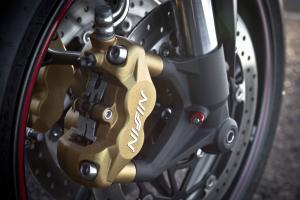
Braking performance from the R's four-pot Nissins is substantial and easily modulated. The shorty levers attached to our demo model stretched the extent of my reach even when adjusted to their minimal setting.
2013 Triumph Street Triple R Intellishift QuickshifterOur Street Triple R was accessorized with frame protectors, billet shorty brake and clutch levers, flyscreen, bellypan, seat cowl, LED indicators, Triumph Intellishift quickshifter, Arrow slip-on muffler and billet aluminum brake reservoirs. The $400 quickshifter features plug-and-play easy installation.

With the optional Arrow exhaust installed – a further 1.8 pound weight reduction and claimed increase of 2 horsepower – the Street Triple R emits an ear-pleasing three-cylinder warble at a respectable decibel level with the baffle removed. Riding an S3R with the stock exhaust, there’s a noticeably enhanced sound coming from the airbox courtesy of a new intake system. Other engine modifications include new throttle bodies and EFI calibrations which, according to Triumph, boosts urban fuel economy by a massive 30% (33 mpg to 43). That sounds wildly optimistic to us, but we’ll have to wait until we test one at home to find out for sure.
2013 Triumph Street Triple R Right SideThe stock and slip-on Arrow exhaust are visually similar. Triumph is making available its Tire Pressure Monitoring System (TPMS) for 2013 Street Triples.
Because the rear subframe no longer supports the weight of the exhaust, Triumph was able to redesign the component using new high-pressure die-casting that shaves 1.8 pounds of weight. The redesign also allowed for increased storage room beneath the seat, enough to conveniently fit a U-lock. All R models feature a red subframe, matching red radiator cowls and red pinstripe wheels, while the optional-on-the-standard-model rear hugger fender is standard equipment on the R.
Beyond cosmetics, what separates the standard Street Triple from its R brethren is non-adjustable suspension, 2-piston front calipers (vs. 4-piston radially mounted calipers) rake and trail figures of 24.1°/ 99.6 mm (vs 23.4°/ 95.0 mm due to suspension differences) and a lower seat height of 31.5 in (vs. 32.3 in due to suspension differences).
2013 Triumph Street Triple R BrakeBut what about pricing? At $9,399 for the standard Street Triple and $9,999 for the R, it seems almost a no-brainer to step up to the better equipped R. Adding $600 to a bike payment over a four-year period is a monthly increase of only $13 (maybe $20 after taxes and freight). You’ll never be able to add those brake and suspension components aftermarket for the same price.
Both models are scheduled to arrive in January. Color selections for the standard model are Phantom Black, Crystal White and Caribbean Blue, while the R model offers Matte Graphite in place of Caribbean Blue.
2013 Triumph Street Triple R Action FrontWould we be content with only a 2013 Street Triple R to ride everyday in all situations? Yes, we would, it’s a motorcycle of incredible diversity.
Triumph Trophy SE 2013 Review

Triumph is billing its new Trophy SE as a luxury tourer, a seemingly appropriate title for its home country whose total square miles amount to less than the state of Michigan. But here, with 47 more contiguous states through which to travel, what defines luxury takes on new meaning. How does the 2013 Trophy SE compare to the established heavyweight luxury tourers from BMW, Harley-Davidson and Honda?
A recent ride beginning in St. Andrews, Scotland, looping through the Highlands of Cairngorms National Park and returning to our origin 250 miles later, proved the Trophy SE has leapfrogged the majority of its competition. Although its styling bespeaks a motorcycle of sport-touring intentions, make no mistake, the SE version of the Trophy (the only iteration coming stateside) delivers on its promise of luxury.


Endowed with a serious arsenal of electronics, the new Trophy SE is light-years ahead of its Hinckley predecessors: the original model from 1991 - 1995 and the second generation from 1996 - 2003. Cruise control, intelligent linked brakes and ABS (non-switchable), traction control (switchable), ride-by-wire (RbW) throttle control, electric adjustments for the headlight and windscreen, and two 12-volt sockets are standard on both models while the SE  also boasts an integrated audio/Bluetooth system, Triumph Electronic Suspension (TES), and a Tire Pressure Monitoring System (TPMS).
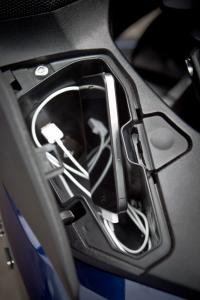
2013 Triumph Trophy 1200 SE Glove BoxThe 2013 Trophy SE is powered by the same 1215cc three-cylinder introduced in the adventure-touring Explorer model which produced 111.7 rear-wheel horsepower at 9000 rpm and 74.6 ft-lb of torque at 6300 rpm in our testing. It should be noted the Explorer made 60+ ft-lb of torque beginning at 2500 rpm and ending at 9300 rpm! The Trophy has a taller sixth gear for improved fuel economy, while other changes include a recalibrated engine management system and a welcome tweak to throttle control. Touchy to the extent of manic on the Explorer, the Trophy’s RbW exhibits none of the too-light throttle-return-spring issues of its adventure-touring counterpart.
Like the Explorer, there’s gobs of torque from basement to roof top. A handful of throttle at 35 mph in sixth gear generates forward thrust without a shudder or knock. Reserve amounts of torque are abundant no matter the speed or gear, the drawback being the omission of a horsepower rush of acceleration. But easy to manipulate power wherever and whenever you want, the Trophy delivers in spades.
On the Sand in St. Andrews
St. Andrews Racing 1920Racing on the West Sands circa 1920. (Photo courtesy of Douglas Turner)
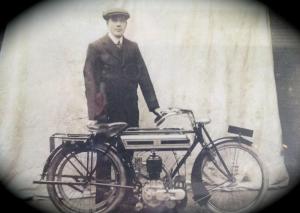
St. Andrews James ChristieA cursory search of St. Andrews, Scotland, reveals a claim as home to the world’s oldest golf course. For motorcycle enthusiasts there’s a much more interesting historical facet to this ancient city. Directly west of the Old Course lay the West Sands – of Chariots of Fire fame – and according to the St. Andrews Preservation Trust, the West Sands hosted motorcycle racing as early as 1909.
Two locals, James Christie and his brother, are attributed with gaining permission from the town council to hold motorcycle racing on the West Sands, with the event organized by The Leven Motorcycle Club.
Between the years of 1913 and 1956 (excluding time off for WWI and WWII), the Scottish Motor Cycle Speed Championships were held on the West Sands. According to an account from the St. Andrews Citizen newspaper, “the Motor Cycle Speed Championship of 1928 attracted 250 entries and over 10,000 spectators attended the event.”
Comparatively, the first official race on the sands of Daytona Beach took place in 1937.

Weighing a claimed 662 pounds wet, sans panniers, the Trophy is approximately 100 pounds heavier than the BMW R1200RT, its inevitable nemesis and the bike we’re aiming to test it against ASAP. Without a ruler by which to measure and compare, the Trophy seems to manage its weight upon a diversity of roads. Not once during our escapade did the Trophy step out of line or exhibit any ill-handling manners.
2013 Triumph Trophy 1200 SE Rear CorneringFrom tight, unmarked, undulating Highlands backroads to high-speed aggressive freeway riding the Trophy competently handled whatever was thrown at it. Triumph claims a 51.5% forward weight bias.
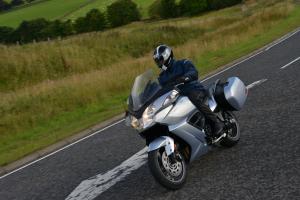
Chock up the Trophy’s good handling to its lightweight frame (24.9 lbs), 190 rear tire, the Triumph Dynamic Luggage System (TDLS), or a combination thereof, but one thing’s for certain, electronics certainly play a part.
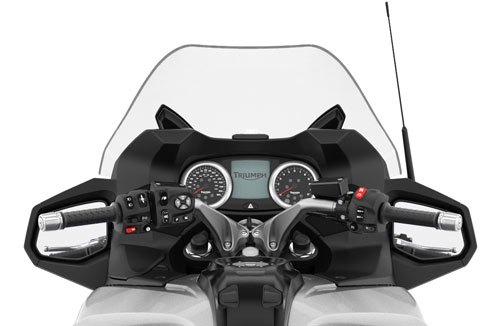
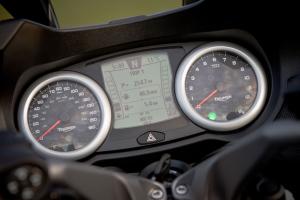
2013 Triumph Trophy 1200 SE CockpitElectronic suspension – adjustable between Sport, Normal and Comfort damping settings on the fly, and preload settings for Solo, Solo plus Luggage and 2-Up when stationary – is a technology we’ve been crowing about since first testing it on the Ducati Multistrada years ago. The ability to change suspension characteristics with the push of a button is a useful, everyday convenience and one a lot of competitors to the Trophy do not possess.
In addition to electronic suspension, the Trophy SE comes standard with switchable traction control, cruise control, non-switchable ABS and intelligent linked braking – when engaging the rear brake, pressure to the front caliper varies by way of a delay valve while a proportional control valve corrects pressure to the rear caliper depending on the amount of pressure being given to the front caliper.
The TPMS (standard on the SE) can also be considered intelligent. To keep from needlessly draining the battery, the system automatically shuts off when the bike is not in motion.
2013 Triumph Trophy 1200 SE Action FrontIn 2012, BMW’s R1200RT retailed for $17,350, so it’s priced below the Trophy, but the standard RT lacks technologies like traction control, cruise control, tire pressure monitoring and an integrated audio system. These features can be added but at a cost that brings the MSRP of the RT equal to that of the Trophy SE. And then you still have an air-cooled Twin with less performance than that of the Triumph’s three-cylinder mill. One big advantage of the BMW is its claimed 100-pound less wet weight – an advantage no technology or aftermarket addition can equal.
As mentioned earlier, the U.S only receives the SE model, and these will come with the low seat as standard equipment (adjustable between 30.7 in and 29.9 in), while a taller seat (adjustable between 32.3 in and 31.5 in) is available as an option. Bikes should be arriving here in late December or early January.
In either guise, the new Trophy has proven itself a serious luxury performance-tourer with handling and an electronics package resembling BMW’s stellar K1600GT/GTL but with half the cylinders.
2013 Triumph Trophy 1200 SE Two BikesThe 2013 Trophy SE retails for $18,999 and is available in either Pacific Blue or Lunar Silver color schemes.

2013 Triumph Trophy Specs
Engine and Transmission
TypeLiquid-cooled, 12 valve, DOHC, in-line 3-cylinder
Capacity1215cc
Bore/Stroke85 x 71.4mm
Fuel SystemRide by wire, fuel injection
ExhaustStainless steel 3 into 1, side mounted stainless steel silencer
Final DriveShaft Drive
ClutchWet Multi-Plate
Gearbox6 Speed Constant Mesh
Oil Capacity4.0 litres (1.1 US gals)
Chassis, Running Gear and Dislays
FrameAluminum beam twin-spar
SwingarmSingle-sided, cast aluminum alloy with shaft drive
Front WheelCast aluminum 5-spoke 17 x 3.5in
Rear WheelCast aluminum 5-spoke 17 x 6.0in
TiresFront - 120/70 ZR17, Rear - 190/55 ZR17
Front SuspensionBase - WP 43mm upside down forks, manually adjustable rebound damping, with 130mm travel.
SE Model - WP 43mm upside down forks, electronically adjustable rebound damping (sport/normal/ comfort) with 127mm travel
Rear SuspensionBase - WP monoshock with remote oil reservoir, manually adjustable hydraulic preload, manually adjustable rebound damping, 120mm rear wheel travel.
SE Model - WP monoshock with remote oil reservoir, electronically adjustable hydraulic preload (1up, 1up+luggage, 2up), electronically adjustable rebound damping (sport, normal, comfort), 120mm rear wheel travel
Front BrakeTwin 320mm floating discs, Nissin 4-piston calipers, linked brakes (front brakes partially activated by rear), ABS (non-switchable)
Rear BrakeSingle 282mm disc, Nissin 2-piston sliding caliper, ABS (nonswitchable)
Front Brake Master CylinderNissin integrated reservoir master cylinder 14mm diameter
Instrument DisplayDual analogue gauges (speedometer and tachometer) with multifunction dot matrix LCD to display trip information with ambient light level brightness compensation, dual trip computers (1 with adjustable automatic reset), fuel gauge, range to empty indication, service indicator, gear position indication, clock, air temperature, frost warning and accessory heated seats/grips status display, hazard warning light button, cruise control status, headlight position adjustment and scroll button on handlebars
SE Model - audio system information, TES status, TPMS status
Dimensions and Capacities
Length2235mm (87.9in)
Width (handlebars)975mm (38.4in)
Height (without mirrors)1435mm (56.5in) - 1555mm (61.2in)
Seat Height770mm (30.3in) - 790mm (31.1in)
Wheelbase1542mm (60.7in)
Rake/Trail27.0º / 119.0mm
Fuel Tank Capacity26 litres (6.9 US gals)
Wet Weight (without panniers)301kg (662lbs)
Pannier Capacity (per side)31 litres (8.2 US gals)
Pannier Max Load (per side)10kg (22lbs)
Performance (Measured at crankshaft to 95/1/EC)
Maximum Power134PS / 132bhp / 99kW @ 8900rpm
Maximum Torque120Nm / 89ft.lbs @ 6450rpm


Triumph Tiger Explorer XC 2013 Unveiled


Triumph’s 1215cc Tiger Explorer can be upgraded to a new XC version fitted with components better able to endure off-road pounding. New to the XC are steel-spoked wheels with aluminum rims that are designed to use tubeless tires, which can drastically simplify puncture repair compared to tubed tires. Wheel sizes remain the same 19-inch front and 17-inch rear as the non-XC’s cast-aluminum hoops – no 21-incher up front like the KTM Adventure that is better able to roll over off-road terrain.
To guard against tip-over damage, the sweet and powerful three-cylinder powerplant gets protection from tubular-steel framework, while an aluminum sump guard shields from below. Hand guards are standard equipment on the XC. Dual fog lights streaming 55 watts each provide extra nighttime illumination. Expect an additional 15-20 pounds on top of the regular Explorer’s 570 ready-to-ride pounds.


Otherwise, the XC is identical to the Explorer we recently tested in our upcoming adventure-touring shootout – stay tuned to see how it stacks up to BMW’s R1200GS, Yamaha’s Super Tenere, Moto Guzzi’s Stelvio NTX and KTM’s Adventure. We loved the Explorer’s 1215cc Triple and its standard-equipment cruise control. Also standard are traction control, switchable antilock brakes and shaft drive. All Explorers have 10,000-mile service intervals and an unlimited-mileage two-year warranty. 
The 2012 Tiger Explorer has a starting MSRP of $15,699. No XC price info from Triumph yet, but it should be safe to assume it will carry a $1000 price premium over the non-XC, just like the 800cc Tigers.


Triumph Tiger Explorer 2012 Review

What’s the Triumph Tiger Explorer got the BMW R1200GS does not? One cylinder and about 50 more pounds of wet weight. At least that’s what we can deduce at this juncture having ridden the two bikes separately but not yet directly compared them.
This will change soon, however, as our annual trek to Laguna Seca for MotoGP includes these two machines, a Yamaha Super Ténéré, Moto Guzzi Stelvio NTX and KTM 990 Adventure. Hundreds of miles of off-road, freeway and twisty pavement will ensue, and we’ll even spend a night camping in the Sierra Mountains. But for now, here’s our take on Triumph’s newest big-bore entry into the Adventure-Touring market.
With minimal off-road riding time, this review largely focuses on the Explorer’s on-road competence, which is apropos as bikes of this nature generally traverse more paved than unpaved miles in their lifetimes. We’ll have a better understanding of its off-road performance whence returning from MotoGP, but let’s get this review underway with an element of equal importance to both types of riding – the engine.

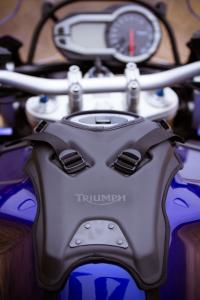
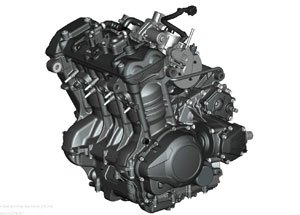
2012 Triumph Tiger Explorer tank bag harness Probably the Explorer’s best attribute is its 1215cc Triple, Triumph’s newest engine powering both it and the forthcoming Trophy SE. Producing a claimed 135 horsepower at 9,000 rpm (500 rpm below redline) and 89 ft-lb of torque at 6,400 rpm, the biggest Tiger in Triumph’s line-up bests its 800cc stablemate by a claimed 41 hp and 31 more claimed ft-lb of torque. Like the Tiger 800, the Explorer’s mill produces gobs of low- and mid-range grunt in a vibration-free power delivery but with more arm-yanking urgency than the 800.

Control of that power is transmitted to the ECU via a ride-by-wire throttle, and while the system seems to work with modern efficiency, it’s also home to the Explorer’s most glaring defect; a ridiculously light throttle return spring. Lacking the proper tension, even the most steady-handed rider cannot stop mild road imperfections from causing movements in the throttle which the engine responds to by minor increases and decreases in speed. Off-road riding, with its coarse topography, will exacerbate this effect.Like BMW’s Paralever design, the Explorer employs a shaft drive with a torsional damping system via a sprung bevel gear in order to maintain the bike’s designed geometric arrangement. To further reduce the adverse effects brought about by a shaft-driven rear wheel, Triumph explains that the shaft is “a two-part ‘metalistic’ shaft, which means that a rubber component sits between two separate shafts to deliver a smoother riding experience.”
The Tiger Explorer is rife with rider aids including cruise control, anti-lock brakes (ABS) and traction control (TC). The simple pleasure of removing your right hand from the grip to stretch and restore blood flow that cruise control offers is worth the admission price. Selectable in 1-mph increments, a rider can choose the exact speed he wishes to travel, take a breather and enjoy the scenery.
2012 Triumph Tiger Explorer fully equippedOur Tiger Explorer test mule was outfitted with Triumph accessories including TDLS panniers, alloy bash plate, two-stage heated rider and passenger seats, two-stage heated hand grips, tank bag (not shown). Grand total: $2,150.
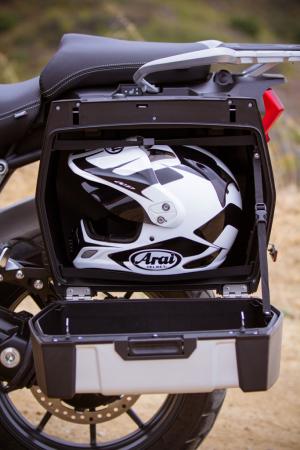
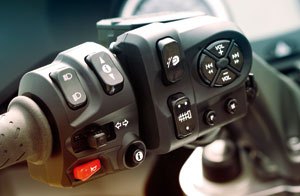
Both ABS and TC are switchable, the ABS for on/off and TC with a choice of two positions (#1 more intrusive, #2 less intrusive) and off. Both functions are controlled via left handlebar button operations and visible on the digital instrument cluster. The ABS isn’t as easy as the BMW’s to disengage but it’s not rocket science and with a few practice runs you’ll have the process mastered. Both functions default to “on” whenever the ignition is keyed off.
Other conveniences of the Explorer include a height-adjustable rider seat and position-adjustable handlebars, while a 950-watt generator powers optional two-stage heated seats for both rider ($370) and passenger ($320), optional two-stage heated grips ($200), optional fog lights ($350), the integrated power supply in the optional top box ($440) and the tank-mounted power socket.
2012 Triumph Tiger Explorer left saddlebag
The Tiger Explorer is available with the same basic optional hard luggage accessories we reported on with the introduction of last year’s Tiger 800 and Tiger 800XC. “The visually rugged saddlebags ($800) are seemingly built to withstand a Dakar-esque get-off, and I liked their lockable, easy-on, easy-off design that will appeal to commuters. But a component is only as strong as its weakest part, and on these saddlebags it’s the attachment point. Twice I witnessed bags break off of fellow journalist bikes during slow-speed, front-end washouts in the dirt. Off-road warriors will wish for more robust mounts.”
While the Explorer’s saddlebags are susceptible to the same easy breakage, the system does boast Triumph’s Dynamic Luggage System (TDLS). In short, the system is said to help maintain chassis balance by allowing each saddlebag to move through a damped five-degree arc. First introduced on the 2004 Sprint ST, the system has, according to Triumph, been advanced during each subsequent iteration and will be present on the forthcoming 2013 Trophy SE.
2012 Triumph Tiger Explorer Dynamic Luggage System rodOn pavement-only Sprint and Trophy models, the loose attachment of the bags isn’t as noticeable and may provide some of the performance benefits Triumph claims, but on the off-road Tiger models the system allows the luggage to bang around noisily and break off easily which negates any perceivable advantage the system might provide on the street.
Another technical option available on the Tiger Explorer is Triumph’s Tire Pressure Monitoring System (TPMS) ($160) that displays air pressure for both front and rear wheels on the 2 x 2.5-inch LCD instrument screen. The instrument cluster also includes a digital speedometer, analog tachometer, gear-position indicator, fuel gauge, range to empty, service indicator, clock, air temperature, frost warning, hazard warning lights and trip computer.Tire sizes of 110/80-19 front and 150/70-17 rear equal that of the GS, while the Explorer’s inverted, preload-adjustable 46mm fork boasts 7.48 inches of travel. The Kayaba rear monshock has 7.63 inches of travel and features a remote oil reservoir, rebound adjustment and preload adjustment from a conveniently located twist knob next to the rider’s right leg. Other niceties include removable rubber inserts inside the footpegs, a centerstand and 90-degree valve stems.
Time spent aboard the Explorer can be described as comfortable, including rider ergonomics (seat in the high position for those taller than 5’ 10”), windflow from the non-adjustable windscreen, and the optional two-stage heated seat installed on our test bike. For 2012 the Tiger Explorer is available in Phantom Black, Graphite and Sapphire Blue.
2012 Triumph Tiger Explorer highwayAn expression often associated with GSX-Rs but also befitting the Explorer is that a rider sits into the Triumph. An adjustable stock seat plus optional 'low' and 'high' seats allow comfort customization.
Is the new Tiger Explorer worth its $15,700, non-accessorized asking price? Possibly. It’s more expensive than Yamaha’s Super Ténéré ($14,500) but less than BMW’s R1200GS ($16,150) so it’s appropriately priced. In a few weeks we’ll have a definite answer as to which bike we prefer. Compared to the 800cc Tigers, the Explorer is more bike, but the lighter, more manageable size of the Tiger 800 and 800XC will get you into and out of more precarious off-road predicaments, leaving you to decide if you require a bike that’s more touring or one that’s more off-road adventurous.
By the Numbers
Price$15,699
Engine TypeInline Triple
Displacement1215cc
Bore x Stroke85mm x 71.4mm
Horsepower135 hp (claimed)
Torque89 ft-lbs (claimed)
FrameTubular steel trellis frame
Wheelbase60.2"
Rake/Trail23.9-degrees/105.5mm
Front SuspensionKayaba 46mm USD Forks w/190mm travel
Rear SuspensionKayaba monoshock with remote oil reservoir, hydraulically adjustable preload, rebound damping w/194mm travel
Front/Rear Wheels19-inch/17-inch cast aluminum alloy
Tires110/80 x 19 Front, 150/70 x 18 Rear
Front BrakesTwin 305mm floating discs, Nissin 4-pistons caliper, switchable ABS
Rear BrakesSingle 282mm disc, Nissin 2-piston sliding caliper, switchable ABS
Fuel Capacity5.3 U.S. gal
Wet Weight570 pounds
Seat HeightAdjustable from 32.9" to 33.7"

Triumph Trophy SE 2013 Review

Since the demise of the Trophy in 2004, Triumph’s Sprint ST and GT have been tasked with representing the touring category for the Brits. That changes later this year with the re-introduction of the 2013 Triumph Trophy SE.
Awash with electronic gadgetry and boasting a relatively low wet weight (662 lbs sans luggage), the new Trophy’s spec sheet resembles that of a BMW. And its look? Well, that’s borderline plagiarism of the R1200RT. After last year’s shootout between the Tiger 800XC and the BMW F800GS – where the visually similar Tiger narrowly defeated the GS – maybe Triumph figures it can do it again in the sport-touring division.

Powered by the same 1215cc three-cylinder introduced in the adventure-touring Explorer model, Triumph claims the liquid-cooled, 12-valve, DOHC inline triple produces 132 crank horsepower at 8,900 rpm and 89 ft-lb of torque at 6,450 rpm. Not exactly K1600 territory, but more than the RT’s claimed 110 hp and an exact match for torque (89 ft-lb at 6,000 rpm claimed for the RT).
Triumpuh Trophy EngineTriumph has replaced the oft-complained-about chain drive of the old Trophy with a shaft final drive on the new version. Like BMW’s Paralever design, Triumph employs a torsional damping system via a sprung bevel gear in order to maintain the bike’s designed geometric arrangement. To further reduce the adverse effects brought about by a shaft-driven rear wheel, Triumph explains that a “metalastic shaft drive is used which allows a certain amount of compliance in the shaft assembly.”
Probably most impressive about the new Trophy is its laundry list of hard-wired components. A standard Trophy will be available in other markets, but only the higher-end Trophy SE will arrive on North American shores.
All Trophys come standard with ride-by-wire throttles, traction control, cruise control, linked ABS (front brakes partially activated by rear), and an electrically adjustable windscreen. According to Triumph, with the push of a button, the windscreen is positionable within a range of 6.5 inches. When restarting the Trophy the system utilizes a memory function to automatically reposition the windscreen to its last pre-set position.
Separating the SE from its common counterpart is an integrated audio system with Bluetooth functionality as well as USB input and iPod/MP3 player compatibility, plus an electronically adjustable suspension package from WP and a Tire Pressure Monitoring System (TPMS).
2013 Triumph Trophy Switch CubeOperated via a left handlebar-mounted “switch cube” and displayed on the Trophy SE’s LCD screen, the Triumph Electronic Suspension (TES) adjusts the rebound damping for the 43mm inverted fork and monoshock to three pre-set positions (sport/normal/ comfort), while the preload of the monoshock can also be stiffened to three different settings depending on load (1up, 1up+luggage, 2up).
The Trophy’s multi-function LCD screen with dual trip computers compensates for ambient light level brightness and displays information including: TPMS and cruise control status, gear position, audio system information, fuel gauge, range to empty indication, clock, air temperature, frost warning, headlight position adjustment as well as settings for optional equipment including heated seats/grips.
2013 Triumph Trophy Instrument ClusterThe Triumph Dynamic Luggage System (TDLS), also introduced on the Explorer, is said to help maintain chassis balance by allowing each 31-liter saddlebag to move through a damped five-degree arc. The optional 55-liter top box, featuring wireless connectability when installing or removing for the 12-volt internal socket, attaches to a sliding carriage which also allows a limited amount of lateral travel. We have yet to thoroughly test this new approach to luggage fitment, but look for a comprehensive evaluation soon.
Seat height for both Trophy models can set to either 30.3 inches or a taller 31.1 inches, while heated front and rear seats are optional additions. Triumph is touting 10,000-mile service intervals, with major services needed every 20,000 miles, and a two-year unlimited mileage warranty.
2013 Triumph Trophy Profile RightWith a fuel capacity of nearly seven gallons, 200+ miles between fill-ups should be easy.
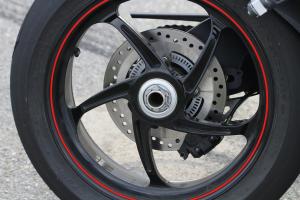
Available in either Pacific Blue or Lunar Silver color schemes, the Trophy SE scheduled isn’t to hit American dealerships until January 2013. Prices will be announced in September. We expect the new Trophy will shake up the pecking order in the sport-touring category.
2013 Triumph Trophy Specs
Engine and Transmission
TypeLiquid-cooled, 12 valve, DOHC, in-line 3-cylinder
Capacity1215cc
Bore/Stroke85 x 71.4mm
Fuel SystemRide by wire, fuel injection
ExhaustStainless steel 3 into 1, side mounted stainless steel silencer
Final DriveShaft Drive
ClutchWet Multi-Plate
Gearbox6 Speed Constant Mesh
Oil Capacity4.0 litres (1.1 US gals)
Chassis, Running Gear and Dislays
FrameAluminum beam twin-spar
SwingarmSingle-sided, cast aluminum alloy with shaft drive
Front WheelCast aluminum 5-spoke 17 x 3.5in
Rear WheelCast aluminum 5-spoke 17 x 6.0in
TiresFront - 120/70 ZR17, Rear - 190/55 ZR17
Front SuspensionBase - WP 43mm upside down forks, manually adjustable rebound damping, with 130mm travel.
SE Model - WP 43mm upside down forks, electronically adjustable rebound damping (sport/normal/ comfort) with 127mm travel
Rear SuspensionBase - WP monoshock with remote oil reservoir, manually adjustable hydraulic preload, manually adjustable rebound damping, 120mm rear wheel travel.
SE Model - WP monoshock with remote oil reservoir, electronically adjustable hydraulic preload (1up, 1up+luggage, 2up), electronically adjustable rebound damping (sport, normal, comfort), 120mm rear wheel travel
Front BrakeTwin 320mm floating discs, Nissin 4-piston calipers, linked brakes (front brakes partially activated by rear), ABS (non-switchable)
Rear BrakeSingle 282mm disc, Nissin 2-piston sliding caliper, ABS (nonswitchable)
Front Brake Master CylinderNissin integrated reservoir master cylinder 14mm diameter
Instrument DisplayDual analogue gauges (speedometer and tachometer) with multifunction dot matrix LCD to display trip information with ambient light level brightness compensation, dual trip computers (1 with adjustable automatic reset), fuel gauge, range to empty indication, service indicator, gear position indication, clock, air temperature, frost warning and accessory heated seats/grips status display, hazard warning light button, cruise control status, headlight position adjustment and scroll button on handlebars
SE Model - audio system information, TES status, TPMS status
Dimensions and Capacities
Length2235mm (87.9in)
Width (handlebars)975mm (38.4in)
Height (without mirrors)1435mm (56.5in) - 1555mm (61.2in)
Seat Height770mm (30.3in) - 790mm (31.1in)
Wheelbase1542mm (60.7in)
Rake/Trail27.0º / 119.0mm
Fuel Tank Capacity26 litres (6.9 US gals)
Wet Weight (without panniers)301kg (662lbs)
Pannier Capacity (per side)31 litres (8.2 US gals)
Pannier Max Load (per side)10kg (22lbs)
Performance (Measured at crankshaft to 95/1/EC)
Maximum Power134PS / 132bhp / 99kW @ 8900rpm
Maximum Torque120Nm / 89ft.lbs @ 6450rpm


Triumph Speed Triple R 2012 Review

When it comes to upping the performance of a vehicle – whether two wheels or four – simply adding the letter R to the name has seemingly become standard practice these days. It’s gotten a bit predictable, actually, and even Triumph has jumped on the bandwagon with the Street Triple and Daytona 675 both recently getting the R treatment, which includes suspension and brake upgrades and of course a few graphic touches to differentiate between the standard models.
It should come as no surprise then to see the iconic Speed Triple as the next in line to receive the R makeover. Specifically, Triumph has outfitted the new Speed Triple R with an Öhlins NIX30 43mm fork in front and a TTX36 rear shock, both tuned with higher spring rates compared to the standard model. Compression and rebound damping in the fork are separated, so each stanchion can focus on its specific task.


Braking duties are beefed up as well with Brembo monobloc calipers replacing the two-piece units on the standard model. ABS is standard on the R model, while still an option on the base version. Futzing with the gauge cluster can turn the system off, but it’s easier said than done.
The next performance modification lies in the wheels. Instead of the cast-aluminum pieces on the base model, R bikes receive forged five-spoke wheels from PVM that, combined shed 3.75 lbs of unsprung weight. Clearly, a big performance upgrade, and the first time Triumph has enlisted forged wheels to complement one of its R models.
The last performance update to the Speed Triple R is a bit harder to see. Transmission internals get a big revamp; 10 of the 12 gears are new, as are internal shafts and shift drum. Shift dogs are up to five (from four on the base model) and ultimately result in a transmission that’s smoother with more positive shift engagement. Further, sixth gear ratio is reduced 3.4%. As simple as these upgrades sound, they go a long way in transforming the character of the Speed Triple from an average, fun motorcycle, to a lean, mean, canyon carving machine. That’s saying a lot since we’ve been fans of the standard Speed Triple for a long time.
2012 Triumph Speed Triple R  forged wheelsIf you’ve been paying close attention, you’ll notice there’s been no mention of any engine upgrades at all. That’s because there aren’t any. The powerplant for both the standard and R version Speed Triple is the same 1050cc inline-Triple that’s become a staple for the brand. It received a slight makeover with the arrival of the revamped standard S3 introduced last year.

While it seems Triumph might have missed an opportunity to set the Speed Triple R further apart from the base model, we certainly have no qualms with the torque-monster triple. “It feels like its torque curve is a long plateau, providing effortless thrust until its top end trails off,” says boss-man Kevin Duke.
The standard Speed Triple is a sweetheart amongst the entire MO staff and puts a smile on all our faces each time we ride one. Which actually poses a challenge for the R version: Would all the new bits on the R justify its $4000 price hike over the base model?
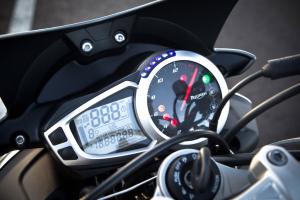
2012 Triumph Speed Triple R analog tachometer digital spedometerAn analog tachometer is paired with a digital speedo to relay important information. Progressive blue shift lights atop the tach are a nice feature, though we wonder why a gear-position indicator – as seen on the Daytona 675 and Street Triple – isn’t included.
Hooligan Reformed
First impressions can be deceiving, as is the case with the S3R. Seating position hasn’t changed on the new bike and this “combination of comfy seat and relaxed, roomy rider triangle allows a Speed Triple pilot to ride the bike for long freeway stints in relative comfort,” says Content Editor Tom Roderick.
However, Tom did notice a slight buzziness creeping through the bars at highway speeds. We think this issue could be alleviated if not for the curious lack of bar-end weights. At the very least they would help protect the controls in the event of a tip-over. “But the S3R’s vibration is more noticeable than bothersome,” Duke adds. “It’s a non-issue for me,” and I’m in agreement.
2012 Triumph Speed Triple R corneringThis is where the Öhlins suspension and lightweight PVM wheels make their mark. The S3R steers quick and is planted throughout any corner.
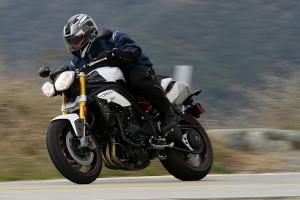
Judging from our relatively comfy freeway impressions, we could have been led to believe the S3R would be a softy in the twisty bits. Once we got to the canyons, however, the Trumpet made it clear it was a hard-edged motorcycle, blurring the line between naked streetfighter and race-ready sportbike.
2012 Triumph Speed Triple R “It has amazingly neutral steering that is aided by the quicker response offered by its lighter PVM forged-aluminum wheels,” says Kevin. As for the Öhlins suspension, Duke noted the suspension’s stiffer springs result in less pitching while braking and remain higher in their strokes over street bumps. “It feels planted in the corners, more so than the regular Speed Triple.”
Riding quickly is made easier when you’re not worrying about gear changes. On the standard model, occasional mis-shifts would kill acceleration. With the R, however, the many changes made within the gearbox really do work to provide smoother, more accurate shifting. We just wish it came with a gear position indicator like its 675cc cousins. When dealing with Brembo monobloc calipers, what is there to say that hasn’t been said already? All three testers raved about the binders, with Kevin calling them “simply excellent!” None of us noticed, let alone complained about, any ABS intervention even during our spirited riding moments. Then again, we never had much of an issue with the standard brakes either. Clutch pull could be described as slightly stiff, though old man (or should we say, drama queen?) Tom described the action as "arthritis-inducing."
Triumph Speed Triple RErgos on the Speed Triple R are unchanged from the standard version, boasting a comfy seat and a relatively open riding position. It also boasts mirrors that are actually functional, unlike some of its rivals.
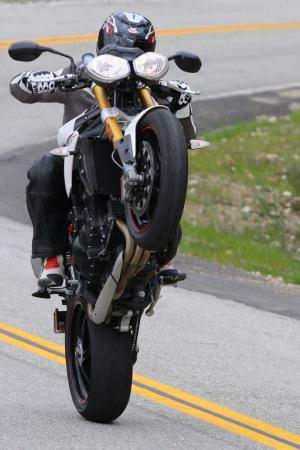
 
R Makes All The Difference
2012 Triumph Speed Triple R wheelieIt’s amazing the difference high-end suspension, better brakes and lighter wheels can make in transforming a motorcycle. Whereas the standard Speed Triple is more than capable to handle the rigorous testing we performed, when judged against the R it suddenly feels soft. Still, that doesn’t detract from its user-friendliness, as all three testers noted how the Speed Triple R is a familiar, comfortable and capable steed.
On the technology front, some might say the Speed Triple R lacks amenities some of its rivals carry, like traction control. However, with ABS standard, Tom makes a strong case towards not needing much else. “Assuming this bike will be ridden among the hazards of freeways and surface streets, ABS is the preferable technology,” he says.At $16,000, the Speed Triple R costs $4300 more than the standard model, which begs the question: Is it worth it? The easy answer is: absolutely, assuming you’ve got the money to spend. “Top-shelf Brembo monobloc brakes, Öhlins NIX30 fork and TTX36 shock live up to their reputations and help justify the $16,000 asking price,” Tom notes. Although he added, “For 16 large I’d like to see more than 122 rear-wheel ponies.”
However, for just suspension updates (albeit significant ones) and no additional power, Kevin has a harder time justifying the cost. “I could make a good case for the Triple-R to be judged as an ultimate streetbike, but I’d balk at paying $4300 more for it than a non-R version,” he says. “For my weight, I could live with the standard suspension, so the only really covetous part of the S3R to me its lightweight wheels.”
Personally, I’d agree with Tom. Try to piece together the suspension, wheels and brakes separately and you’d spend much more than four grand. You’d also have a weapon that could not only own the streets, but would also be a riot at a trackday. Which, coincidentally, is exactly where we’re taking the Speed Triple R next, along with two of its contemporaries in the naked bike category, the Aprilia Tuono V4R and MV Agusta Brutale R 1090. Stay tuned for our Euro Streetfighter Shootout to see how they all fare.
2012 Triumph Speed Triple R At over four grand more than the standard Speed Triple, the R version is a serious jump in price. However, if you can afford it, you won’t be disappointed.

Triumph America 2012 Review

Think of cruisers, and the usual suspects come to mind: Harley-Davidson, various offerings from Japan’s Big Four, Victory – in fact, nearly every OEM builds a bike to tap into the lucrative cruiser market.
Triumph, better known for its hooligan-making naked roadster Speed Triple or its GS-inspired big trailie Tiger, wasn’t a name that surfaced much in cruiser circles. But that changed in 2004 with the introduction of the Rocket III, powered by a monstrous 2,294 cc (140.0 cu in) inline-Triple. The big, rear-tire-roasting power cruiser had cruiser fans’ heads spinning. Then in 2009 the British bike maker again caught the attention of cruiser lovers with the introduction of the Thunderbird and its large-displacement (1597cc) vertical-Twin, a bike that impressed us so much that we named it our Cruiser of the Year in 2009.
However, before these bruisers burst onto the scene, Triumph already had a model entered in the cruiser genre.


The humble Triumph America is but a blip on the radar when cruiser riders gather to talk shop. Even within Triumph’s world the America sits quietly in the background while the sales-dominating Street Triple 675 (and R model) and other sports bikes steal the limelight. Admittedly, even we haven’t given the America much attention in the past 10 years. But a recent ride on a current model year America revealed that shoppers in the cruiser market shouldn’t overlook this cruiser-ish Brit bike.
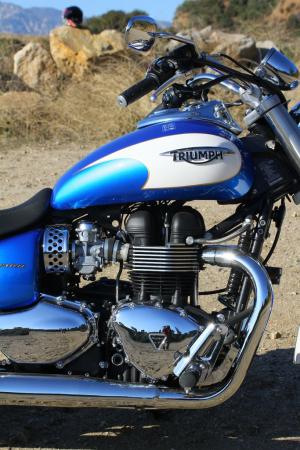
2012 Triumph America Action Despite being a humble middleweight, the America has many features that make it feel and look like a bigger cruiser. Part of that bigger bike appeal is a very roomy, comfortable ergonomic layout.
Triumph America: Not Your Daddy’s Cruiser
2012 Triumph America EngineIn a world of tha-thump-tha-thump-tha-thump V-Twins, the America’s smooth-running, fuel-injected, 865cc vertical-Twin is a unique break with cruiser engine tradition. If you’re looking for a rumbling, raucous ride – one that causes the entire bike to shudder – take note that the America’s 270-degree firing interval has endowed the engine with a quiet-as-a-mouse character when compared to most Harleys and many Japanese cruisers. But if you’re more concerned with enjoying the scenery than about how many passersby are noticing your thundering exhaust, then the gentle Triumph Twin deserves your attention.
Despite the humility of the America’s engine it is by no means ill-suited to motivating the bike’s 550-pound ready-to-ride weight. The America’s as-tested 50 hp at 6500 rpm and respectable 47 ft-lbs at 3400 rpm accelerate the English-made cruiser briskly, with smooth, predictable fueling across the rev range. And while I suspect the engine could easily handle an additional cog in its gearbox, the 5-speed trans nevertheless shifts slickly and is complemented by a light-action clutch.
The first-gen America rolled on cruiser-classic wire wheels, but the most current issue wears 12-spoke cast-aluminum wheels that project a more muscular appearance. Attached to the front wheel is a single 310mm brake disc clamped by a Nissin two-piston caliper, while a 285mm disc and Nissin two-piston caliper slow things from the back. The front caliper handily slows the bike from speed with crisp, authoritative braking action. Applying both calipers simultaneously to retard the America’s forward progress left me wishing that more cruisers in the market offered the same degree of feel and power as what the America provides.
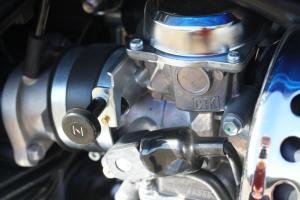
2012 Triumph America throttle bodiesWith a chubby-looking front tire (130/90 x 16) the America doesn’t strike the impression of a light-steering cruiser. And the 33.0-degree rake, 5.62 inches of trail and rangy 63.6-inch wheelbase don’t exactly scream “Snappy steering!” Despite these lazy figures the America is anything but sluggish between turns – though the long wheelbase does make tight-radius U-turns challenging at times.
A notably wide, pull-back handlebar allows plenty of steering leverage, and once set into a corner the America is wonderfully stable and tracks accurately throughout the arc of a turn. While the America is a cruiser, it doesn’t suffer from ultra-restrictive lean angle clearance; it will drag a peg, but not as soon as you might expect.
The America’s 41mm Kayaba fork has nearly 5 inches of road-imperfection-gobbling suspension travel. A set of dual coil-over-spring, preload adjustable shocks have 3.77 inches of travel (considerably more than almost any Harley) but provide a slightly firm ride over larger freeway expansion joints and bumps. Generally, though, ride quality is better than average, whether on surface streets or peeling off the miles on the interstate.In his 2002 review of the America, John Burns said that he thought the America wasn’t “trying desperately hard to look like a Harley-Davidson.” Ten years later that insightful statement is still valid, but for reasons I can’t quite nail down, the America’s styling (with the exception of its engine) strikes me as similar to a Japanese cruiser.
2012 Triumph America leaningPerhaps the America’s easily seen and inexpensive-looking stamped-steel mount holding the speedo, or the poorly routed clutch cable that brushes against the inside of the left header pipe, are what remind of similar budget-saving tactics I’ve seen time and again on other brands. On the other hand, the judicious use of rich chrome in all the right places offsets some of the less attractive bits.
The America’s ample engine power, more than adequate stopping force and friendly handling make a compelling package. But it’s perhaps the roomy and relaxed ergonomics and large-bike feel and look that stand out as this cruiser’s two most prominent qualities. You’ll sit mostly upright in the large, wide saddle (the passenger seat is also roomy), and the sweeping-arced handlebar makes for a natural, easy reach. The footpegs are mounted forward just enough to complete the relaxed rider triangle, yet you never feel like you’re slouching in the seat that’s a scant 27.1 inches off the ground.
The analog speedo’s prominent placement is handy, mirrors provide a clear, useful field of view, and the clutch and brake lever have a 4-position reach adjustment. The layout of the rider environment is such that freeway jaunts of 50-plus miles click off with minimal effort. A small windscreen from the aftermarket would optimize comfort during time on the SuperSlab.
Finally, the large headlight, wide seat, wide handlebar and voluminous 5.1-gallon fuel tank all work to create the sensation you’re aboard a much larger motorcycle without making the America feel overly big or cumbersome.
With a base MSRP of $8299 ($8599 for two-tone colors) the Triumph America is comparably priced to Kawasaki’s Vulcan 900 Classic ($8299 – $8499) or Harley’s Sportster SuperLow ($7999 – $8499) and the V Star 950 ($8490) from Star.
2012 Triumph America Right SideThe America hits most of the right cruiser notes but also offers something a little different from the usual crowd of Harleys and Harley clones.
But each of those middleweight cruisers fit roughly within the same mold. The America hits most of the right cruiser notes, but its distinct vertical-Twin power source is refreshingly atypical in this class.
If you’re looking for something a little different without straying too far from the well-worn cruiser path, make sure to give the America a first, and then second look.

 
Design by Wordpress Theme | Bloggerized by Free Blogger Templates | coupon codes