Showing posts with label Suzuki Reviews. Show all posts

Tuesday, May 14, 2013

Suzuki Motorcycle Lineup 2013

In response to the recent announcement that American Suzuki Motor Company would “wind down” its automobile business in the U.S., Suzuki has decided to refocus its energy to its motorcycle, ATV, and marine production – good news for powersports enthusiasts, and great news for Zook fans everywhere.
At its 2013 Dealer Show in Las Vegas this week, Suzuki announced its motorcycle lineup for the coming model year would feature 47 motorcycles. That’s a big leap from the 10 (you read that right) it offered just three years ago. Suzuki is celebrating its golden anniversary in 2013, and to commemorate the milestone, it’s releasing five new additions to its lineup, including two brand-new bikes, all of which should be hitting dealers by the end of the year. Suzuki also teased us with an updated V-Strom 1000 which is in the pipeline.
C90T Boulevard B.O.S.S.


Highlighting the MY2013 lineup is the introduction of the C90T Boulevard B.O.S.S. (“Blacked Out Special Suzuki”). Initially unveiled earlier this year at Intermot, the B.O.S.S. is a reincarnation of the dearly departed Intruder 1500, a class left bereft by Suzuki when the company discontinued the VL1500 in 2009. A 1462cc touring cruiser, the C90T features dark styling, a broad windscreen, sculpted sidebags, floorboards, a pullback handlebar, and a comfy saddle. Suzuki has dumped the “Intruder” moniker, opting instead to place the midsize tourer in the middle of its Boulevard lineup. The bike presages next year’s release of the standard C90 Boulevard, which will be available in a variety of colors and accessories. Stay tuned for a full review of the B.O.S.S.
2013 Suzuki C90T Boulevard B.O.S.S. OverheadThe hard saddlebags are upholstered in the same leather as the C90T’s saddle.

GW250
The 250cc category has hotted up with the arrival over the past year of Honda’s CBR250R and Kawasaki’s Ninja 300, and now Suzuki enters the fray with an entry-level standard, the GW250. Powered by a liquid-cooled 248cc parallel-Twin engine via a six-speed transmission, the GW250 features an upright riding position, advanced instrumentation and “Baby B-King” appearance that should be a hit with entry-level riders leery of sportbikes. A relatively low 30.7-inch seat height will help the GW be fairly easy to manage despite its hefty 403-pound curb weight. Its price has yet to be announced, but it must be less than $5000 to be competitive with the CBR and Ninja.
2013 Suzuki GW250 Front RightThe entry-level category gains a new player with the 2013 Suzuki GW250, known as the Inazuma in other markets..


Hayabusa ABS
Suzuki announced an ABS-equipped Hayabusa for MY ’13, now featuring the addition of Brembo monobloc front brake calipers like its GSX-R brethren. It retails for $14,399.
2013 Suzuki Hayabusa Limited Edition ABSThe iconic Hayabusa gets upgraded with Brembo monobloc brakes for 2013. The striking, limited-edition yellow version pictured here costs $200 more than the base version.


GSX-R1000 Commemorative Edition
Suzuki reached a milestone in 2012 that it says no other manufacturer can claim: one million bikes of a particular motorcycle model produced. The company rolled its one millionth GSX-R off the production line earlier this year. To honor this achievement, the company is releasing a limited edition of the seminal sportbike, producing just 1,985 Commemorative Edition GSX-R1000s, referencing the 1985 model year in which the original GSX-R750 was introduced.
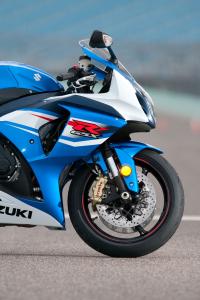
2013 Suzuki GSX-R1000 Commemorative Edition Front RightThe 1,000 GSX-R1000 Commemorative Editions coming to the U.S. will retail for only $200 more than the $13,799 standard model.


The CEs feature cosmetic upgrades to help them stand apart, including special paint and a seat cowl, plus many red highlights – pinstriped wheels, shock spring, fork caps, lettering on the Brembo brake calipers and front fairing accents. Also unique are the serial production plate, gold-anodized fork tubes and the inclusion of a commemorative key fob.
Burgman 650 ABS
The king of the large-displacement scooters, the Burgman 650 also gets several updates for 2013, including antilock brakes. Its bodywork is revised, with a slimmer tail section and new headlights, plus a new set of gauges. Revisions to its CVT transmission dramatically reduce rolling resistance, resulting in a claimed 15% improvement in fuel economy and less drag when pushing it around with the engine off – a common complaint among Burgman owners. Standard equipment now includes an electrically adjustable windscreen and rider backrest, items previously only available on the Executive edition.
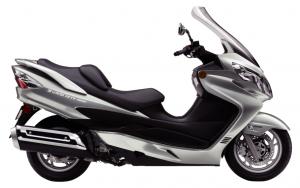
2013 Suzuki Burgman 650 ABS

Finally, although we couldn’t get our hands on an image from those tight-fisted Suzuki reps, it shouldn’t be long before spy photos of the 2014 V-Strom 1000 begin to trickle in. Stay tuned.

Suzuki Hayabusa LE 2012 Review

By now you’ve probably seen our picks for Best Motorcycles of 2012, which means you already know our highest honor, Motorcycle of the Year, belongs to the new Kawasaki ZX-14R. This is great news for Kawi fans, but loyal MO fans and fellow speed freaks will know we still have high praise for the ZX-14R’s bitter rival, the Suzuki Hayabusa. For 2012, ‘Busa diehards have one more thing to rejoice about: the Hayabusa Limited Edition (LE).
For an extra $300 above the $13,999 price of the standard model, LE versions come in Candy Sonoma Red, an exclusive paint job the standard bikes don’t receive. With only 583 LE units being imported for 2012, rest assured you’ll be in exclusive company should you own one.


As a way of saying thanks, after purchase and registration of an LE, Suzuki will send a commemorative placard, designed to fit on the front tank bolt, featuring the registered owner's name and production number of the bike (out of 583). Owners will also recieve a special backpack as well.
Otherwise, the difference between the two motorcycles is nil. Not the most exciting update to a motorcycle, especially in the face of the new ZX-14R.
Limited Edition Hayabusa Placard and BackpackWith only 583 LE models coming to the states this year, the commemorative placard (left) and backpack are fun conversation pieces you can use to distinguish yourself from most other Hayabusa owners.
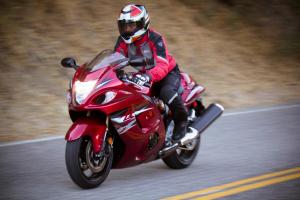
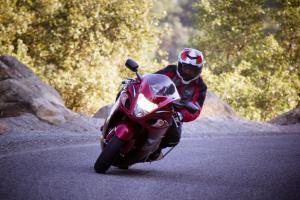
As the Japanese manufacturer seemingly hit hardest by the economic downturn, Suzuki has been slow to significantly update its largest displacement sportbike. When you consider the latest ‘Busa has been virtually the same since 2008, when it received its first update since its inception nine years prior, waiting almost another decade for an update doesn’t seem so far-fetched. Maybe competition from Team Green will expedite the process.
However, despite the passage of time and advancement in technology, there’s something brutally raw about an inline-Four engine displacing 1340cc, pumping 171.0 horsepower and 101.7 ft.-lbs of torque. Especially when it’s connected to two wheels. Though it may be getting long in the tooth, the Hayabusa still demands respect.
2012 Suzuki Hayabusa LE Dyno Chard

To produce so much power, the compression ratio is set at 12.5:1, all 16(!) valves are titanium, cams receive more lift than the previous model, 12-hole injectors feed a fine mist of fuel, while an advanced ECU keeps a watchful eye on all the tiny explosions occurring inside. It can also quell the power (and/or its delivery) via three different power modes, selectable at the push of a button. To produce this power reliably, crankshaft and pistons are forged, while con rods are of the shot-peened chromoly flavor. 
The Hayabusa has long been a favorite of the Motorcycle.com staff, satisfying our need for speed, as well as our desire to explore the open road. With the addition of aftermarket luggage it serves as a remarkably capable sport-touring rig. That is, if you’re under six-feet tall. “The ‘Busa feels a little cramped with the seat positioned close to the handlebars,” says six-footer Tom Roderick.
2012 Suzuki Hayabusa 1340 Action 04Legroom is a little tight even for small fries like Duke and yours truly, though for a motorcycle tipping the scales at a claimed 573 pounds, from the saddle it doesn’t feel overtly large. And this feeling is carried over into curvy roads as well. Though it’s not lithe and nimble like a GSX-R600, its GSX-R heritage is evident, as side-to-side transitions and stability while cornering are impressive for such a big machine.
Credit for this goes to a capable chassis complemented with a 43mm inverted Kayaba fork in front and single shock in rear, both fully adjustable. These components not only provide excellent handling in the twisties, but also comfortable damping when simply putting down the freeway (if such a thing is possible on a bike this quick). Four-pot calipers and 310mm discs up front slow the ‘Busa, but they show signs of fading after repeated heavy usage.
2012 Suzuki Hayabusa 1340 Action 01Despite its relatively aggressive seating position, “The Busa has excellent upper-body wind protection, especially with a full tank bag,” says Chief Duke. “And legs are generously sheltered, too.” Combine this comfort behind the windscreen with the available power, and it’s easy to find yourself “cruising” at triple-digit speeds unknowingly.
Of course, it’s no secret the Hayabusa’s purpose in life is to go as fast as possible in a straight line. Since top speed is governed at 186 mph, we instead turn to quarter-mile times as a barometer of performance. On a particularly warm day at Auto Club Famoso Raceway, near Bakersfield, California, with temperatures in the triple digits, quarter-mile-king Duke blasted the ‘Busa to a raw time of 9.81 seconds at 145.6 mph. Corrected for temperatures and pressure, this equates to a 9.48-second run. Either way, that’s blisteringly fast.
2012 Suzuki Hayabusa 1340 Drag 03For those who choose to ride fast and furiously on the ‘Busa, know that it chews up (most) contenders a quarter mile at a time.


So while the Hayabusa might be a little dated at this point, it’s definitely aging gracefully. However, it’s no secret Suzuki has met its match with the all-conquering Kawasaki ZX-14R. You already know who the winner is between these two combatants, but the margin of victory is not as big as you might think. We’ll have that comparison test coming to you soon.

Suzuki DR-Z400S 2012 Review

Balancing the demands of street and off-road riding is a dual-purpose motorcycle’s cross to bear. Some D-P bikes list with emphasis given to one discipline or the other, such as Husqvarna’s TE250 which is nothing more than a dirtbike with the minimal requisite legalities. Suzuki’s DR-Z400S, however, combines the worlds of off-road and street riding with an equilibrium unmatched by competing models.
The DR-Z is the only D-P bike of Japanese origin displacing 400cc. Honda and Kawasaki skirt the category with offerings in the 230cc (Honda only), 250cc and 650cc displacements, while Yamaha provides one 200cc and two 250cc models. Euro manufacturers such as Beta, Husqvarna and KTM produce comparable machines in the 350cc, 310cc and 450cc, and 350cc displacements, respectively, but like the aforementioned TE250, these bikes are thinly disguised off-roaders.


The 400cc DR-Z bridges the gap between the modestly powered 250cc models and the oftentimes overweight and street-biased 650cc models. Compared against its DR-Z650SE stable-mate, the 317-pound curb weight of the 400 bests its kin by 49 pounds and produces surprisingly similar horsepower numbers. Our 400S cranked out 31.2 hp, while the 650 we tested in our 2007 Three for Five: Budget Bombers article pumped out 35.3 ponies. The big DR’s extra displacement shines through in the torque readings, churning out a significant 10.4 ft-lb more than the 400’s 23.5 ft-lb.
While the 650’s extra torque is certainly beneficial, when it comes to finessing a bike over and around various off-road obstacles, we’ll take the lesser weight of the 400 rather than the power advantage and heavier weight of the 650.
2012 Suzuki DRZ-400S Off-Road TrailsNavigating narrow singletracks in loose conditions is much easier on the DR-Z400 than its bigger-displacement rivals.

When we tested Yamaha’s WR250R last year, the 298-pound (wet) machine output 27.7 hp and 17.0 ft-lb of torque. With the DR-Z weighing only 19 pounds more than the Yamaha but boasting 3.46 more horsepower and 6.52 ft-lbs of torque, we’re attracted to the realistic possibility of shedding some of the 400’s weight, bringing it closer to that of the 250’s rather than attempting to close the 50-pound gap between the 400 and 650.
After a day of swapping the Suzuki for the Husky TE250 (see our forthcoming shootout), it is our opinion that by reducing the DR-Z’s weight, stiffening its suspension and installing some aggressive rubber on its rims the DR-Z can be transformed into a serious off-road weapon. While shaving the DR-Z down to the TE’s 255-pound wet weight is impractical, getting it close to or below 300 lbs is within reason.
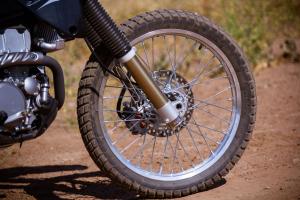
2012 Suzuki DRZ-400S Front WheelA fully adjustable, 49mm front fork with 11.3 inches of travel combined with a rear shock adjustable for preload and compression damping with 11.8 inches of travel are formidable suspension components. Plush stock settings smooth minor street imperfections but are easy to bottom out during aggressive off-road riding. Stiffening both front and rear components allows a rider to better explore the DR-Z’s capabilities.
Not the best we’ve tested, but stopping power from the DR-Z’s 250mm front disc brake with a dual-piston caliper and a 220mm rear disc brake with a single-piston caliper is more than adequate. The front brake delivers a strong initial bite and is easy to modulate which is crucial when off-roading with the small-knobby stock front tire.
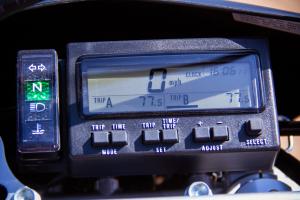
In addition to its streetable rubber, Suzuki equipped the DR-Z with road-going niceties such as a digital instrument cluster with twin-trip meters (with addition/subtraction capability), a clock, timer and stopwatch functions. There’s also passenger footpegs, a helmet lock and a thick, although narrow, seat providing relatively more comfort than true dirt bikes.
2012 Suzuki DRZ-400S Instrument ClusterWhile the 398cc, DOHC, liquid-cooled Single produces usable amounts of low-end torque, Suzuki equipped the DR-Z with a five-speed gearbox that limits a rider’s choice of power delivery. While most 650cc D-P bikes also utilize five gears, we’d prefer the 400 to have a six-speed gearbox like the majority of small- and mid-displacement D-P bikes.
Southern California highways and their common 80-mph flow of traffic (when traffic is flowing) is a little much for the DR-Z. The engine is spinning quite fast to keep that pace which makes for a buzzy experience. At 65 mph and under the single-cylinder engine thumps along at a tolerable cadence. A sixth cog in the DR-Z's transmission would go a long way in making the DR-Z a better freeway machine.
2012 Suzuki DRZ-400S Water CrossingDirt, pavement or water, the DR-Z attacks them all with aplomb. 


A glaring oversight of DR-Z engineers is the simple omission of brush guards. Certainly not a deal breaker but when Suzuki’s own DR650SE – a less dirt worthy model than the DR-Z400S – comes with these off-road-inspired items as standard equipment, it just makes you wonder why they didn’t install them on the 400. Another un-dirtbike-like facet of the DR-Z is its metal tank. One wrong dismount (which is an accepted aspect of aggressive off-road riding) and the DR-Z’s metal tank will forever wear a dented reminder of the event.
The Suzuki DR-Z400 has no direct competition in terms of displacement and price, making its performance and $6,200 MSRP a combination that’s hard to dismiss. The DR-Z is equally competent on the street as it is in the dirt. For the person wanting an enduro that can navigate a single-track or fire road as well as perform daily commuting duties and even some short adventure-touring trips, the DR-Z is a D-P bike worthy of consideration.

Suzuki GSX-R1000 2012 Review

There’s a reason why national superbike grids around the world are stacked with Suzuki GSX-R1000s. With 37 championships in the past 10 years, the pedigree and performance potential of the venerable Gixxer speaks for itself. Making up at least 45% of the AMA Superbike field since 2009, the GSX-R has a reputation for winning. Of course, just when you think it can’t get any better, it always does. Introducing the 2012 Suzuki GSX-R1000. 
At first glance, the new GSX-R looks pretty similar to the outgoing model. It still has a funky trapezoidal headlight, familiar lines and the distinctive blue and white color scheme. According to Suzuki, the 2012 model is a “refined version of the fifth generation.” Perhaps the first thing visually different is the single exhaust that replaces the twin exhaust setup of the 2011 version. Another visually obvious change is a switch to Brembo monobloc calipers (in gold to separate them from its silver 600/750 brethren) and red pinstriping around each wheel.


Leaner and Meaner
Along with the switch to the single muffler design this year, the under-engine chamber is also gone. The 4-2-1 stainless steel exhaust gains a little pipe length before meeting with the titanium exhaust canister. Following these outward updates the remaining changes come from within, focusing primarily on the engine, but also on the chassis. The design goals for the new engine include reducing weight, improving low- and mid-range torque, better throttle response and higher fuel mileage. Interestingly, though, Suzuki didn’t highlight increased peak power as an objective for the new mill.

Using finite-element-method (FEM) and fatigue-analysis techniques borrowed directly from MotoGP, the new GSX-R’s pistons are 11% lighter and yield a slightly higher compression ratio of 12.9:1 (from 12.8:1).To help the engine breathe better and reduce pumping losses, pentagonal crankcase vents replace the box-shaped vents seen on the previous model.
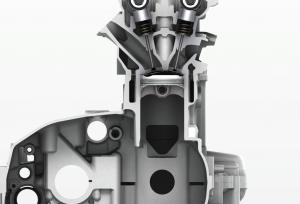
2012 Suzuki GSX-R1000 CutawayNew camshaft profiles include slightly more lift on the exhaust side, and valve-overlap duration has been shortened a smidge as well. The four-valve-per-cylinder layout is retained with the valves still made from titanium. The revised cam profiles along with the retuned exhaust and subsequent ECU recalibration is said to give the newly updated GSX-R1000 engine a broader torque curve than before without losing any of the top-end hit from the previous model.
Next, the chassis got the Jenny Craig treatment. As mentioned earlier, the 2012 Gixxer ditches the extra exhaust canister it had a year ago, reducing the overall width 15mm to 705mm (27.8 inches) while also losing a significant amount of weight.
2012 Suzuki GSX-R1000 Front WheelThe new Brembo calipers are lighter than the outgoing Tokico calipers as well, but also provide more positive braking power and feel, not only because of their construction, but also due to slightly larger caliper pistons. Rotor thickness is scaled back to 5.0mm from 5.5mm in order to reduce unsprung weight, but rotor diameter stays the same at 310mm. All told, the new GSX-R1000 is 4.4 pounds lighter than last year.
Bump absorption comes from Showa’s Big Piston Fork that sees a few tweaks this year. The new forks are 7mm shorter in length, with a 5mm reduction in stroke. Suspension settings are accordingly softened to accommodate the bike’s weight loss. Out back, the same fully adjustable shock from the previous model is carried over without any changes.
Other odds and ends include a new arrangement for the front axle that now utilizes an outer thread and nut, rather than the hollow bolt and inner thread used previously. Not only does this eliminate the need for a special tool to take wheels off, it also sheds 39 grams. Seat height remains the same at 31.9 inches, but the seat’s now covered in a grippier material to keep the rider from sliding around unintentionally.
2012 Suzuki GSX-R1000 Rear WheelThe rear of the GSX-R1000 reveals a missing left muffler, as seen on the 2011 model. Also, exhaust plumbing underneath the engine is cleaned up dramatically with the elimination of the exhaust chamber seen last year.
What About T/C?
After reviewing all the improvements to the new GSX-R1000, one glaring omission from the list is traction control. The latest trend in sportbikes these days is equipping a motorcycle with T/C from the factory; it’s like a right of passage in the eyes of the general consumer. With the amount of power today’s literbikes put out, surely an electronic safety net is needed to protect riders from themselves, right?
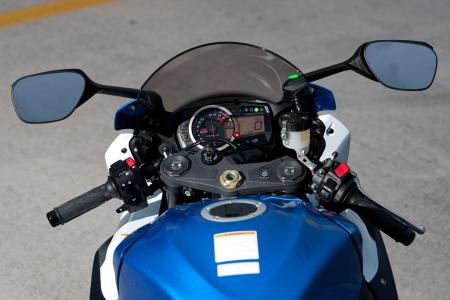
2012 Suzuki GSX-R1000 GaugesSuzuki doesn’t think so. Its philosophy is to engineer a motorcycle with handling characteristics that will communicate to the rider and warn them if the rear is spinning. Like Honda and its CBR1000RR, Suzuki’s stance on T/C isn’t to simply incorporate the system just because its competitors are doing so. It’s definitely a technology being researched (and surely being developed behind closed doors), but we’ll have to wait for a future model before we see it in production.
Own The Racetrack
To see if its newest creation lives up to its “Own The Racetrack” tagline, Suzuki invited journalists to Homestead-Miami Speedway in Florida to put the new GSX-R1000 through its paces. We were greeted with gloomy weather and under constant threat of rain. Rain tires weren’t needed, but the standard Bridgestone Battlax Hypersport S20 tires were replaced with the more track-oriented Racing R10. Front tire size remained the same, but the rear 190/50-17 S20 was substituted for a 190/55-17 R10.
Sitting on the new GSX-R feels instantly familiar to all the GSX-R models I’ve ridden in the past. You sit “in” rather than “on” the Suzuki. Immediately noticeable once the new G1K is rolling is the bump in low-end power. Homestead’s infield layout consists mainly of slow- to medium-speed bends that lead to sizable straights, and squirting out of these turns on the new Suzuki reveals the increase in grunt within the engine.
2012 Suzuki GSX-R1000 Action LeftIt’s easy to get comfortable on the latest Gixxer Thou if you’ve liked the ergos of previous models. With plenty of room to scoot around in the saddle and adjustable footpegs, riders of many shapes and sizes are accommodated.
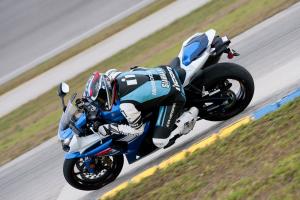
I’ll admit to being suspicious when told why traction control was missing from the GSX-R. With a host of electronics already equipped, including the Suzuki Drive Mode Selector system, I figured adding T/C would be a natural next step. Excuses or not, the connection between throttle and rear tire is superb, as the sometimes-damp conditions would cause the rear to spin when accelerating. It was never an issue, however, and controlling the slide was a simple matter of modulating the right wrist.
2012 Suzuki GSX-R1000 Action LeftSpeaking of S-DMS, in its latest iteration it’s no longer needed to press and hold the button to change modes. Now, a simple tap does the job and it can be done on the fly. After riding in A mode for much of the day, tapping to B mode reveals distinct steps in power. The first pull starts from idle to 3000 rpm, then from 3000 rpm to 10,000 rpm. During both of these segments, power delivery is noticeably softer than A mode. Once the engine is spinning above 10,000 rpm full power is restored, kicking in with a force hard enough to scoot you back in the saddle. C-mode neuters power to the point where it’s simply not fun to ride anymore.
While this latest GSX-R1000 continues Suzuki’s evolution of refinement, unfortunately this wasn’t reflected in the gearbox – shifting was notchy and harsh at times. Deliberate pressure on the shifter during clutchless upshifts was crucial to a successful gear change. Gearing felt tall for this particular track, as rarely did I need more than third gear, even on the oval portion of the track, though this is more an indication of just how powerful modern literbikes have become.
Braking power from the new Brembo monoblocs is everything we’ve come to expect from the brand. Monstrous stopping ability is a simple matter of squeezing the lever harder. Modulation was equally impressive, making it easy to trail-brake right to the apex.
2012 Suzuki GSX-R1000 Action RightDespite a highly composed front-end under braking, feedback at full lean didn’t inspire complete confidence in the front.


Thanks to the Big Piston Fork, composure under braking was equally excellent. After that, however, finding confidence in the front end was a struggle. The changing weather conditions or the concrete patches in every turn could be partially to blame, but it was an issue I heard other journalists also mumbling about. Having not ridden its predecessor for some time, it’s hard to judge the new Gixxer’s flickability, though it does feel on par with the rest of its Japanese contemporaries in this department. 
Still King of Sportbikes?
Some might wonder if Suzuki has done enough to surpass its competition both in the dealership and the racetrack. With a price-point set at $13,799, $200 more than the 2011 version, equal to the 2012 Honda CBR1000RR, and $200 less than the traction-control-equipped Kawasaki ZX-10R and Yamaha YZF-R1, Suzuki has placed the new GSX-R right in contention. With bottom-end power close to that of the Honda — and similar front ends — the battle between the two will be tight.
2012 Suzuki GSX-R1000 Action FrontMake no mistake; the GSX-R1000 is still a solid performer. Improvements to the engine’s low-end power make a big difference, but time will tell if the improved power, the Brembo brakes and attractive pricing are enough to give it the nod in the ultra-competitive literbike market.

One thing the Suzuki has on its side is its popularity in the aftermarket world. Virtually any performance part or accessory is available for every GSX-R, giving you the ability to customize it to your liking. In addition, Suzuki is making it more attractive than ever to buy one of its motorcycles, scooters or ATVs, regardless of model year, with an industry-leading 0% finance offer for five years, for all regular tiers through March 31, 2012. Additionally, select models, including the GSX-R, are also eligible for $1000 off through March 31st.
With deals like that, the new GSX-R might have success in the sales wars, but there’s only one way to know if it will “Own the Racetrack.” We’ve been plotting our 2012 literbike shootout, and over the next few weeks we’ll pit all of the major contenders, including the GSX-R1000, against each other for both street and track superiority. It promises to be an epic test and one that’s not to be missed. Stay tuned.

Suzuki V-Strom Review 2011 & 2012 Review

In 2002 Suzuki proclaimed a new category of motorcycling, “Sport Enduro Touring,” defined by the V-Strom 1000. I fondly remember testing the bike because of its ability to touch down passenger footpegs. “The V-Strom is a comfy sport-touring rig that aptly handles fireroads and twisty two-laners (some better than your average sportbike),” I wrote. The following year the V-Strom 650 was added to the stable. The 1000 didn’t make US shores for the last few years but both it and the Wee-Strom will carry the Sport Enduro Touring torch into a second decade with the forthcoming 2012 models.
Joining the previously announced 2012 V-Strom 650 are two new versions of the bike, the V-Strom 1000 Adventure and V-Strom 650 ABS Adventure. According to Suzuki the new 650 Adventure comes equipped with accessories such as “aluminum side cases large enough to fit a full-coverage helmet, a rugged accessory engine bar and an adjustable windscreen,” while the 1000 merely gets nylon (read plastic) Givi-style panniers and a top box. We’ll report more on these new models as information becomes available.


So, in advance of our ride on the 2012 V-Strom 650, we went to task refamiliarizing ourselves with the 2011 iteration garnished with ABS and hard saddlebags. It took only a short period for the Suzook to remind us what a great all-’rounder the V-Strom was, is and most probably will remain to be.
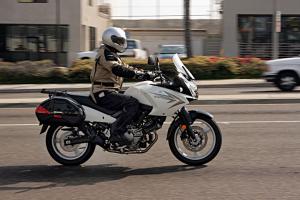
2011 Suzuki V-Strom 650 ABSBalanced is a word that surfaces often with the small Strom and rightly so. The 645cc fuel-injected V-Twin produces spunky power, revs to its redline without hesitation and is easy to manipulate in the dirt (as much as a bike with a 485-pound curb weight can). Front and rear suspension never feel over-taxed, providing compliant riding in all but the most extreme riding scenarios. The seating position is comfortably standard and surprisingly low (32.3 inches) for a bike with 6.9 inches of ground clearance.
With the V-Strom 650’s ability to conform to a variety of duties including grocery shopping, touring and moderate off-roading, the ABS feature asserts itself as a safety advantage. Thankfully, an emergency situation never arose where I put the ABS to use, but knowing it was there while traversing among drivers whose attention is subverted by smart-phone indiscretions is a psychological advantage.
The 2012 V-Strom has updates best described as evolutionary, not revolutionary. The V-Strom’s fuel-injected engine receives new innards including pistons, rings and cylinders and a modified cam profile claimed to result in improved low-end torque and high-end horsepower as well as better fuel economy.
2012 Suzuki V-Strom 650 ABSA recognizable profile, but new styling brings a fresh face to the 2012 V-Strom.
Suzuki shrunk the fuel tank from 5.8 to 5.3 gallons and halved the weight of the ABS components, both reductions helping bring the 2012 Strom’s curb weight down to 472 pounds, 13 less than the current model. Seat height has increased 0.6 inches to 32.9 inches, and Suzuki is offering optional seats; one of lesser height (32.1 inches) and one of greater height (33.7 inches).
MSRP on the 2012 V-Strom 650 ABS is $8,300, while the one-thousand — with no ABS and no restyling externally or otherwise — will retail for $10,400. Both models are scheduled to arrive in dealerships in November and we’ll have a full test of the 650 ABS by the time they do, so stay tuned!
Saddlebags For A Steal
When it’s time for some light-duty touring, riders need to take along belongings necessary to making multi-day traveling a congenial experience. Saddlebags are the most prevalent means of storage. And, as luck would have it, we noticed during our research that Suzuki is offering its hard saddlebag system, normally an $1100 option, at a clearance price of only $200. The same deal also applies to a bag set for the new-for-2011 GSX1250FA.
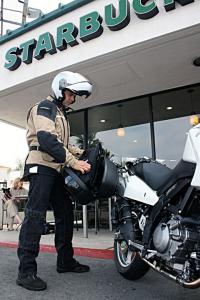
Suzuki V-Strom 650 SaddlebagsJust two-hundy for a set of hard bags is an apparent steal, as most factory bag systems cost more than $1000. However, our testing revealed a few compromises in the design of these Suzuki accessory items.
To begin with, the 35-liter bags do not fit full-face helmets, are not waterproof and require a key separate from the ignition key to function. The bags are nicely styled for street use, but the color-matched upper portion and large rear reflector wouldn’t hold up well in an off-road tip-over. Additionally, the latching mechanism leaves a person guessing if the bag is securely closed.
The bag package includes mounting brackets designed to work with both the V-Strom 1000 and 650. The 1000, however, has dual exhausts while the 650 owns only a single muffler hanging from the right rear side beneath the passenger seat. With or without the bags removed there’s a cavernous gap where a ghost muffler resides on the Wee-Strom.
Quick and easy mounting and removal benefits commuting and local errand running. For touring we suggest packing gear inside a watertight interior softbag, as the closure seal isn’t quite water-tight. Having said all that, at $200 the luggage remains a bargain and worth the discounted price — at $200 the hard saddlebags are only $50 more than aftermarket soft saddlebags! Even with the bags’ faults, it’s hard to pass up a deal this good.


Suzuki Burgman 400 ABS 2011 Review

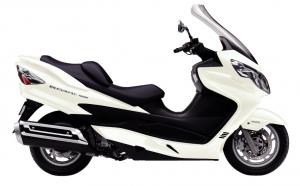
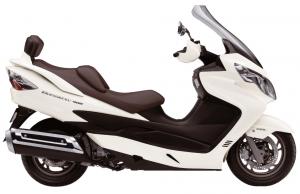
There are a lot of labels to describe the niche that Suzuki’s Burgman aims to fill: Touring scooter. Maxi-scoot. Super scooter. But there’s one brand that the Burgman 400 ABS should wear with pride: car replacement. Bigger scoots like the Burgman always defy classification – especially stateside – because they’re not a motorcycle and they’re not a scooter, but they offer a heaping helping of what’s to like about both those categories.
Scooters are a tough sell in car-centric America. We only seem to really want them when we’re either sporting fat wallets and are desperate for the next recreational toy, or when we’re skint and desperate to save gas money by any and all means possible.
The bottom line is that Americans usually fail to see the value proposition of a two-wheeler that seems to be some sort of weird compromise between big bike and tiny scooter. Chalk it up to the stigma scooters have in a country where nearly every TV show about motorcycles involves someone building a billet-laden V-Twin with a jaw-dropping paint job and an unconquerable rake.


Whatever the reason, Suzuki’s Burgman 400 ABS is a scooter that can change that perception. Why? Because it delivers – a lot. The Burgman appeals to both the sense of fun that many prospective riders seek from a two-wheeler, while simultaneously dealing out a healthy dose of practicality.
And that’s not a new idea for larger scooters. In fact, it dates back to 1950s and 1960s Germany. While Southern Europeans were buzzing through tight city traffic on smaller Vespas and Lambrettas, German manufacturers such as Heinkel, Maico and Zündapp were building larger scooters with larger displacements and bigger wheels to serve a different set of needs. Riders in more spread out, more suburban, Northern European areas needed something that could get them longer distances to work, as well as let them hit the road on for some weekend traveling. If anything, what the Germans sought to accomplish with scooters a half-century ago is exactly what today’s max-scooters deliver: two-wheel transportation that is a true alternative to a car.
Spend a day on the Burgman 400 ABS and you’ll come to see exactly what those German manufacturers had in mind. It provides an ample amount of power, handling, mileage and, strangely enough, storage space to make you forget four-wheel transportation exists.
2011 Suzuki Burgman 400 ABSStarting with the ride, the Burgman offers a mixed, but overall positive package of riding characteristics. The 400cc DOHC thumper offers up plenty of power. In fact, it feels like a surprising amount of power given the scooter’s 490 pounds. Paired with the CVT transmission, the scooter has surprisingly quick take off from the line — even uphill — and has enough power at any position in the throttle to get you free from traffic or trouble. The phrase twist-n-go definitely applies. 
And it’s important to note the ride is surprisingly smooth as well. Even when being remorselessly flogged, the Burgman serves up a steady ride with minimal vibration or noise. The result is that the combined smoothness and the CVT results in the Burgman riding fine cruising at any speed. Faster travel on the freeway to standard city speeds, the scooter always seems to be comfortably cruising. It’s not until you approach redline that you really lose that sense of comfortable cruising.
In terms of handling, the scooter carves nice, graceful curves and is a joy in sweepers. It’s not until you start hitting tighter corners and decreasing-radius turns that the Burgman’s handling feels a little more ponderous. That’s most likely attributable to the scooter’s weight combined with a wheelbase that is longer than your everyday city scooter. Suffice it to say that the Burgman just isn’t flickable like other, smaller scooters. You’re not going to throw it around as much, but that’s not necessarily a downside. I’d rather call it a limitation inherent in most maxi-scoots.
2011 Suzuki Burgman 400 ABSAlso, it should be noted that because of the Burgman’s size, I found myself holding off on much filtering in lane-splitting friendly California. The Burgman is just wide enough that the prospect of wiggling between rearview mirrors seems more like a chore than a short cut. That size can also be a downside in the wind. A couple romps in some fairly strong crosswinds made me wonder why I was feeling the buffeting like I was, and the only conclusion I could draw was there’s a whole lot of plastic body panels there to get pushed by strong gusts.
But of course the braking is what’s special about the 2011 edition of the Burgman 400, and the anti-lock braking is exactly what this scooter needs. Because of a heavier weight being carried by smaller tires, grabbing handfuls of brake means those smaller diameter tires risk getting overwhelmed and losing traction. Anti-lock braking just plain makes sense for the Burgman. The Burgman’s ABS proved itself very handy on a couple of occasions during our testing. Using the ABS, the stopping power of the 260mm front and 210mm rear discs was instantaneous with no juddering or traction loss in a hard, short stopping. Rather, the ABS delivers a very rapid yet smooth stop that doesn’t leave the rider frazzled.
The front fork’s 110mm of travel graciously accepts any hard braking with minimal dive, and paired with the rear monoshock, the suspension evens out the road nicely, but still gives a controlled ride so that cruising on the Burgman never feels disconnected from the road.
In terms of styling, I actually prefer the Burgman 400 ABS to the Burgman 650 Executive. Because it doesn’t offer the power mirrors, larger, powered windscreen, or the seat backs of the 650, the 400 looks more sporty and aggressive. The fact that the 400’s signal lights are incorporated into the main light clusters, as opposed to the 650’s mirrors adds to that more streamlined and motorcycle-like appearance.
2011 Suzuki Burgman 400 ABSColor-wise the 2011 Burgman 400 ABS comes in a metallic gray and a metallic white. Some vehicles look good in white, and some do not, and when they do not, they can look pretty darn cheesy. In this case, the white finish truly complements the Burgman’s lines. The gray looks great, but the white has a slight metal flake to it that actually winds up looking classy indeed.
But you can’t talk about the Burgman’s ride without talking about its utility, and it’s in its cargo capacity where the Burgman really stands out. All in all, the Suzuki offers roughly 16 gallons of storage space. Up front is a decent-sized glovebox and two smaller storage compartments near the instrument panel. Under the seat is where the real storage is.
In fact, that underseat storage space is somewhat of a revelation. Starting out the day, the Burgman happily accepts a cover, a laptop bag and a lunch bag while offering plenty of room for more stuff. Get to work, and you can remove those items and replace them with your helmet, jacket/commuter suit and gloves. In fact, you can actually stow two full-face helmets if you need to. The result is that no matter where you go, you don’t have to walk around dressed like a Power Ranger, and you don’t have to endure looking like a high school student by having to constantly wear a backpack or messenger bag.
And when you want to hit the road and go for a trip, the Burgman’s storage capacity really proves its worth. For years, I used to scooter camp on old Vespas and Lambrettas with all my gear bungied to front and rear racks. The resulting visual was that of a two-stroke gypsy. By comparison, you’d never know whether a Burgman was packed to go camping or not. Its trunk happily gobbled up a compact summer sleeping bag, an ultra-light tent, an air mattress, an overnight bag, a backpacking stove and small pot, food and some other small camping essentials. A small fuel-bottle and some other odds and ends went in the front glove box with room to spare. Packing the scooter took less time and trouble than setting up camp.
Maybe the compromise between motorcycle and scooter offered by larger scooters such the Suzuki Burgman 400 ABS is a tough concept for some folks to grasp. Then again, if they had even a few days of saddle time on this versatile two-wheeler, they’d quickly realize that compromise can be pretty eye-opening — and a hell of a lot of fun.


Suzuki Boulevard M109R Limited Edition 2011 Review

What kind of bike would you bring to a superhero rally? The recent Comic Con International drew teeming masses of wannabe do-gooders, villains, brain-munching zombies, merciless monsters and other dark denizens of sci-fi, horror and graphic novel to this celebration of all things out of this world. The Suzuki M109R Limited Edition fit right in like a warm gun at a knife fight.
Suzuki blew up the emerging power cruiser market when it launched its half-cruiser, half-sportbike beastie in 2006. A massive, 109 cubic-inch (1783cc) engine was implanted as the bike’s cruel heart. Hot-rod styling cues, such as the fashionably fat 240mm rear tire, low-slung seat and top gun riding position were added for proper menacing attitude. The 127 crankshaft hp (about 106 horses at the wheel), fire-snorting, liquid-cooled V-Twin was ready to wreak havoc on the American avenue.


The project was an unholy amalgam of the race-honed GSX-R superbike and the undead remains of the popular but musty Intruder. The M109R ("M" for mighty; “R” for racing) was dubbed the new king of the cruisers by some jaw-dropped pundits when it first scorched the asphalt. Critics derided its chunky style and chubby 764-pound curb weight, but the M109R added a new dimension to the sport-cruiser category.
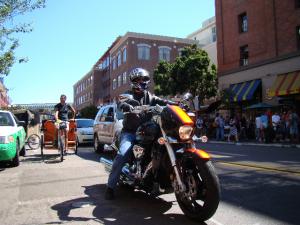
2011 Suzuki Boulevard M109San Diego’s sci-fi convention features the film and print world’s most fanatic followers. Herds of costumed characters and caped crusaders spilled out of the convention center and into the town’s Gaslamp Quarter, parading, primping, growling, posing and becoming the superhero or mad monster they adore most.
Sci-fi premieres were everywhere, but as I rode the M109R down possibly crime-ridden boulevards and darkened alleys, ready to rescue damsels in short dresses, I knew in my heart Captain America had nothing on me.  The M109R shot about town like a rolling secret weapon on a mission, ready to shift into a thunderous menace. For a few summery days in this lovely seaside city, I felt like the king of the zombies, or at least a superhero’s apprentice.
The Suzuki provided a mind-blowing rush beyond whatever Comic Con’s best nerd-brains could imagine. Rolling amid the trikes built to look like starships, the cars hung with time-machine-like bodywork, and the walking comic book characters dressed to kill, the M109R stood out as a real-deal rocket ship, albeit bound to an earthly street, a minor inconvenience to a leathered crusader.
2011 Suzuki Boulevard M109The M109R shoots off the line like a speeding bullet, smoothly accelerating through its powerband with resolute aplomb. The drivetrain’s only drawback is the fixed limit of its five-speed gearbox. The engine is so full of pep it begs to be galloped out to at least a sixth gear.
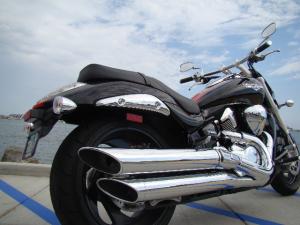
New this year for the M109R series is this Limited Edition cosmetic package that commands a $400 sticker bump to $14,500. It’s distinguished by its Glass Sparkle Black/Candy Max Orange paint and black (rather than silver) wheels. The package is finished off with a white/gray fade-pattern speedo backdrop on the tank-mounted gauge panel, a textured seat with Suzuki Boulevard logo and a clear lens for the LED taillights. 
The original M109R design was so well thought out, we wouldn’t want Suzuki to change much aside from adding an overdrive transmission gear or perhaps the option of some nicely integrated hard bags, easily detachable and big enough to hold enough stuff to get you down the road for a weekend or more. Some riders may like a windshield or even—egad—a fairing, but that would just not be the superhero way. Besides, we like the wind and bugs and other such road splatter smashing us in the mouth at 75 per. It’s just part of the pure cruiser experience, which is what the M109R represents — avenue-assassin looks with super biker powers.
2011 Suzuki Boulevard M109Media Girl meets her match.


The boulevard blaster is a surprisingly comfortable ride, handling long-haul duties as well as it rips up asphalt with all the might its rated 118 ft-lb of torque (about 100 ft-lb at the wheel) will muster. A quick twist of the wrist can send your eyeballs bouncing to the back of your head and the bike rearing up on its haunches like a spooked racehorse. Just how we like it, even if our army of corporate attorneys likes to send us memos about power is nothing without control and other such pesky blabber that makes our heads hurt. Fortunately, Suzuki has taken care of this for us, creating a monster machine with polite manners.
2011 Suzuki Boulevard M109The bike’s architecture didn’t stop with simply shoehorning a big-ass motor into a cruiser chassis. Handling is superbly delivered via a high-tensile steel frame built to absorb huge twists of torque. Inverted for greater stability and strength, the front fork boasts hefty 46mm tubes, providing a healthy 5.1 inches of front wheel travel.
A cast aluminum swingarm, progressive shock linkage and a preload-adjustable shock provide a firm but comfortable ride and 4.7 inches of rear-wheel travel. The four-piston, 310mm dual disc front brakes and twin-piston, 275mm rear disc competently reels in the black beauty. Spiral spoke cast aluminum wheels, 3.50 x 18-inch front and 8.50 x 18-inch rear and wrapped in Dunlop, round out the suspension. Simply put, the bike handles a lot better than looks possible.
Another surprise is how cozy the M109R’s seat is. Set wide but low at 27.8 inches, the plush saddle will leave you with happy butt even after hours of droning down the superslab. The passenger seat, covered by a plastic cowling when not in use for that cool bad-boy, lone-rider look, is also deceptively engineered by being more comfortable than it appears.
From the side it doesn’t look like your pillion is going to like you, but look at the Suzuki’s seat from the rear and it suddenly appears to have twice the butt placement area, a small but significant detail consistent with the bike’s unordinary design, and one that will keep couples together at the end of a long ride. A 5.2-gallon tank, fuel economy around 35 mpg, and more creature comforts than one would expect from a hardcore cruiser, and the Suzuki M109R almost asks to be flogged all damn day.
2011 Suzuki Boulevard M109Suzuki's M109R pounds out big power and competent handling to earn a deserved spot near the top of the muscle-cruiser category. 


As with all motorcycles, there are intangibles to consider when measuring Suzuki’s flagship cruiser. From the throaty dual exhaust that reminds us true biking is not dead to spot-on ergonomics, the M109R drips superhero sex appeal. The cockpit puts the rider in the most badass profile possible, legs forward and spread at a most cocky angle.
The M109R is an empowering machine, motorcycling fun at its core, and the kind of ride that can turn the average, mild-mannered rider into a street hero.

Suzuki V-Strom 650 ABS 2012 Review

After a slow trickle of information from a series of teasers to last week’s deluge from an apparently accident leak, Suzuki has officially unveiled its updated 2012 V-Strom 650 ABS.
Initial reaction on the blogosphere to last week’s leak was rather tepid. After several teasers hinting at a “new middle-class motorcycle”, many expected Suzuki to introduce a dramatically changed new V-Strom, perhaps somewhere in the 800cc segment to compete against the new Triumph Tiger 800 and the BMW F800GS.
Proclaiming it “time for real adventures”, Suzuki’s teaser campaign hinted at something more off-road oriented than the previous Wee-Strom. The reality turned out to something still better suited to pavement than dirt.


When the first images and specs emerged, the perception was the 2012 Suzuki V-Strom 650 was, as the cliché goes, more evolutionary than revolutionary. But perhaps that isn’t such a bad thing. The previous V-Strom 650 was a very capable machine, powered by the well-received engine inherited from the Suzuki SV650 and SFV650 Gladius.
062611-2012-suzuki-v-strom-650-abs-Engine_CEOR.jpgThe new V-Strom uses an updated version of the SV650 engine, a favorite among the Motorcycle.com editors.
The fuel-injected engine on the 2012 Suzuki V-Strom has the same bore and stroke as the previous version (81.0mm x 62.6mm), but it has been updated with new pistons, piston rings and cylinders. According to Suzuki, the updated engine offers higher torque at low-to-mid revs, thanks to a modified cam profile, as well as more horsepower at the high end. Suzuki also claims a 10% improvement in fuel economy, allowing for a slimmer, lighter fuel tank with a capacity of 5.3 gallons from 5.8 gallons. Claiming a curb weight of 472 pounds, the 2012 V-Strom ABS is about 13 pounds lighter than the 2011 version.
The new V-Strom uses the same aluminum twin-spar frame and swingarm as the previous model. The front suspension uses 43mm telescopic forks with five spring preload adjustments and 150mm of stroke. The rear suspension also offers adjustable spring preload, with fine adjustments made with a knob located under the frame cover on the right side.
Like the 2011 model, the V-Strom 650 will only be available with ABS. According to Suzuki, the ABS components are lighter and more compact on the 2012 model, weighing 1.5 pounds, less than half the previous ABS system’s 3.3 pounds.
062611-2012-suzuki-v-strom-650-abs-Strip_RightSide_CHJY.jpgThe 2012 Wee-Strom uses the same aluminum twin-spar frame as the previous version. The new muffler has a buff-finished end cap and silver metallic cover to protect optional side cases from excessive heat.
The seat on the 2012 V-Strom 650 is new, with an embossed logo and red stitching. At 32.9 inches, the standard seat sits 0.6 inches higher than on the previous version, which, according to Suzuki, reduces rider fatigue for long-distance riding. For riders with longer or shorter legs, Suzuki is offering a couple of optional seats that are change the seat height to either 33.7 inches or 32.1 inches.
062611-2012-suzuki-v-strom-650-abs-Seat.jpgThe standard seat is 32.9 inches from the ground, but Suzuki will offer optional seats for taller and shorter riders.
062611-2012-suzuki-v-strom-650-abs-FuelTank.jpgA slimmer fuel tank combined with the new side vents give the 2012 V-Strom 650 a narrower shape than the previous version.
Design-wise, the new Wee-Strom is slimmer than the previous version. The narrower tank helps make it easier to put your feet down despite the higher seat, while the previous version’s side plastics have been replaced by black resin air outlets, a change intended to improve cooling and provide better wind protection. The windscreen offers three adjustable settings, with the upper edge in the default setting 30mm set back from the 2011 model’s windscreen.
Behind the seat, Suzuki replaced the aluminum rear carrier and passenger grab handles with a lighter black resin components that are lighter and less affected by ambient temperature.
Another update is the new instrument panel with an analog tachometer and brightness-adjustable LCD display. The LCD screen displays a gear indicator, fuel gauge, ambient temperature and odometer/trip meter/fuel consumption. The tachometer also features a coolant and oil temperature warning and a road freeze warning that lights up when the road temperature approaches freezing.
The 2012 V-Strom 650 will be produced in three colors, though only two will be offered in the U.S. American consumers can choose between Metallic Fox Orange and Glass Sparkle Black while other markets will be offered the Pearl Mirage White.
The 2012 Suzuki V-Strom 650 ABS will arrive in American dealerships in November, though pricing remains to be determined. Suzuki will also offer a number of accessories, though the North American offerings have yet to be finalized.
062611-2012-suzuki-v-strom-650-abs-DL650AL2_Diagonal_YVB.jpgThe 2012 Suzuki V-Strom 650 ABS will be available in North America in black or orange. The white version seen in the close-up shots will be available in other markets.
Suzuki GSX1250FA 2011 Review

A new motorcycle with sporting intentions but absent ground-breaking technology or a race-winning pedigree is easily overlooked. Enter the 2011 GSX1250FA, a semi-new model from Suzuki lacking advertising superlatives but delivering the essential qualities that comprise a competent motorcycle, i.e., performance and fun at an affordable price.
The Suzuki GSX1250FA is the bike a discerning motorcyclist will pick out of a line-up of overly specialized sportbikes or portly sport-tourers emphasizing the latter part of the compound title. Besides its standard equipment anti-lock brakes, the GSX1250FA is elemental in its construction and built to be ridden anywhere, anytime by a motorcyclist who values versatility over hyperbole.
Stripped of its Bandit moniker, in use since the Bandit 400’s U.S. introduction in 1991, the GSX1250FA also differs from its predecessor by way of full-fairing cosmetics. Less obvious upgrades include heavier fork springs and firmer rebound damping, and an additional radiator fan to compensate for the loss of airflow from the full-coverage bodywork.


Albeit the changes are minor, the bike’s new plastic-clad profile should generate interest from motorcyclists familiar with the previously naked or quarter-faired versions as well as those without knowledge of the GSX’s past nomenclature. And when those who previously dismissed the Bandit get a chance to test the GSX1250, they’re gonna be surprised by the bike’s well-mannered, universal performance.
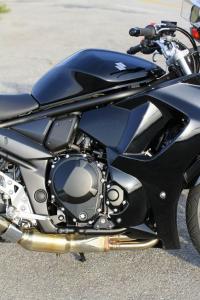
The GSX1250FA’s engine is certainly one of the bike’s best qualities. With maximum torque at a V-Twin rpm (72.3 lb.-ft. at just 3,500) the GSX romps out of corners with a robustness that belies its modest 92.6 hp at 8,800 rpm dyno figure. The abundance of low-end power augments real-world usability and ensures you’re never left wanting when running a gear high or in need of emergency passing power. It should be noted, however, that as pleasurable and user-friendly as the fuel-injected 1255cc inline-Four is, considering its displacement, we were hoping for at least triple-digit horsepower numbers.
2011 Suzuki GSX1250RA
A surprising attribute of the GSX1250FA is its handling prowess, especially considering its low-tech tubular steel frame and 567-lb curb weight. It’s no Jenny Craig poster child, but in the canyons the GSX manages its weight well and will easily keep on the rear wheel of faster, lighter bikes piloted by lesser riders. Competitive models such as the new Kawasaki Ninja 1000 and Yamaha FZ1 are lighter and better handling, but without these bikes playing devil’s advocate, a GSX1250FA operator will be riding in ignorant bliss of the bike’s weight problem.
As capable as the GSX is in the canyons, it’s equally at home digesting freeway miles in commuter mode or during long-distance road trips. Ergonomics are comfortable with plenty of seat-to-footpeg legroom and a moderate reach to the superbike handlebars. The suspension is well-balanced on the plusher side for extended seat-time comfort. It’s only in the canyons, during aggressive braking and cornering, when the bike’s weight occasionally overwhelms the suspension, but otherwise the bike’s 43mm fork and single rear shock keep the GSX composed.
2011 Suzuki GSX1250RAThe GSX1250 is bigger and heavier than some of its smaller rivals, but it handles much better than we expected. Accommodating ergonomics and a broad, plush seat provides excellent long-haul comfort.
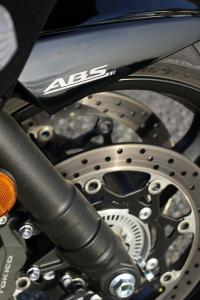
Throttle response from Suzuki’s Dual Throttle Valve fuel-injection system is faultless, delivering smooth controllable application of power at any rpm, and a stout clutch offers a wide engagement zone for smooth launches. The GSX’s triple-disc brakes provide a very firm lever and decent feedback to slow the GSX with confidence. Adjustable brake and clutch levers fit a variety of hand sizes.
The GSX’s ABS system is the bike’s most advanced technological component, but unless an emergency situation arises it’s a system that runs unnoticed in the background. I did pound the brakes a couple times to confirm the existence of the system was more than just stickers on the front fender. The system sends a familiar pulsating sensation through the levers when activated, but will stop the bike with authority. Equipped with ABS as standard, the GSX1250FA stands apart in its category. 2011 Suzuki GSX1250RAFor those with a penchant for traveling, the new full-fairing provides more protection from the elements than the old quarter-faired Bandit. However, we deemed the bike’s styling more reminiscent of an aftermarket lower cowl back-ordered from the late 1990s than a cutting-edge 2011 model. From the front, the GSX-R-derived stacked headlight is much more in vogue. Gusts coming over the windscreen hit my 5-foot-11 frame about mid-chest in a clean, non-turbulent flow of air. Suzuki also offers a more touring-oriented windscreen as well as a 37-liter top box and hard, lockable and detachable saddlebags, which can morph the GSX into a sporty big sport-touring rig.
The seat of the GSX1250FA provides a two-position height adjustment, altering from 31.7 to 32.5 inches, but changing over the seat tray to a different level is the most complicated processes of seat height adjustment we’ve ever encountered. You’ll want to pick the most appropriate level and leave the seat in that position.
Besides the child-proof seat, the GSX does possess two rarities a lot of future owners will respect. The first one is a centerstand. Yes, it adds a little weight and can limit cornering clearance when the bike is loaded with a passenger and gear, but this apparatus is essential for lubing and adjusting a chain whenever you’re away from home.
2011 Suzuki GSX1250RAThe GSX's suspension is a good compromise between over-the-road comfort and composure during moderately aggressive riding conditions.
The other nicety is a pair of helmet locks located under the seat. I don’t know why manufacturers are leaving this simple addition off a lot modern motorcycles, but I’m tired of having to carry my helmet into a restaurant when it would be perfectly safe attached to the bike. Thank you, Suzuki, for using common sense and including this function on the GSX1250FA.
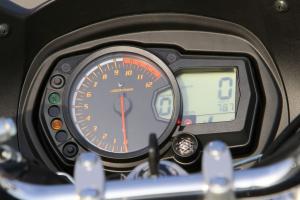
The instrument cluster is clean and easy to read, and it includes a handy digital gear-indicator window, another feature absent on similar models.2011 Suzuki GSX1250RACarrying an MSRP of $11,599, the GSX1250FA is a bargain, especially considering ABS is included in this price. If you’re in the market for a new motorcycle that slots between a dedicated sport-tourer and a sporty standard, the GSX1250FA should be on your list of considerations. Its best selling point is its engine that delivers locomotive-like power when and where you need it, and its handling easily exceeded our expectations.
So if you can swing a test ride from your local dealer, give the GSX a chance. You’ll probably be as pleasantly surprised as we were.
2011 Suzuki GSX1250RAThe GSX1250FA's centerstand tucks up nicely and is indispensable for maintainance during long trips.

 
Design by Wordpress Theme | Bloggerized by Free Blogger Templates | coupon codes